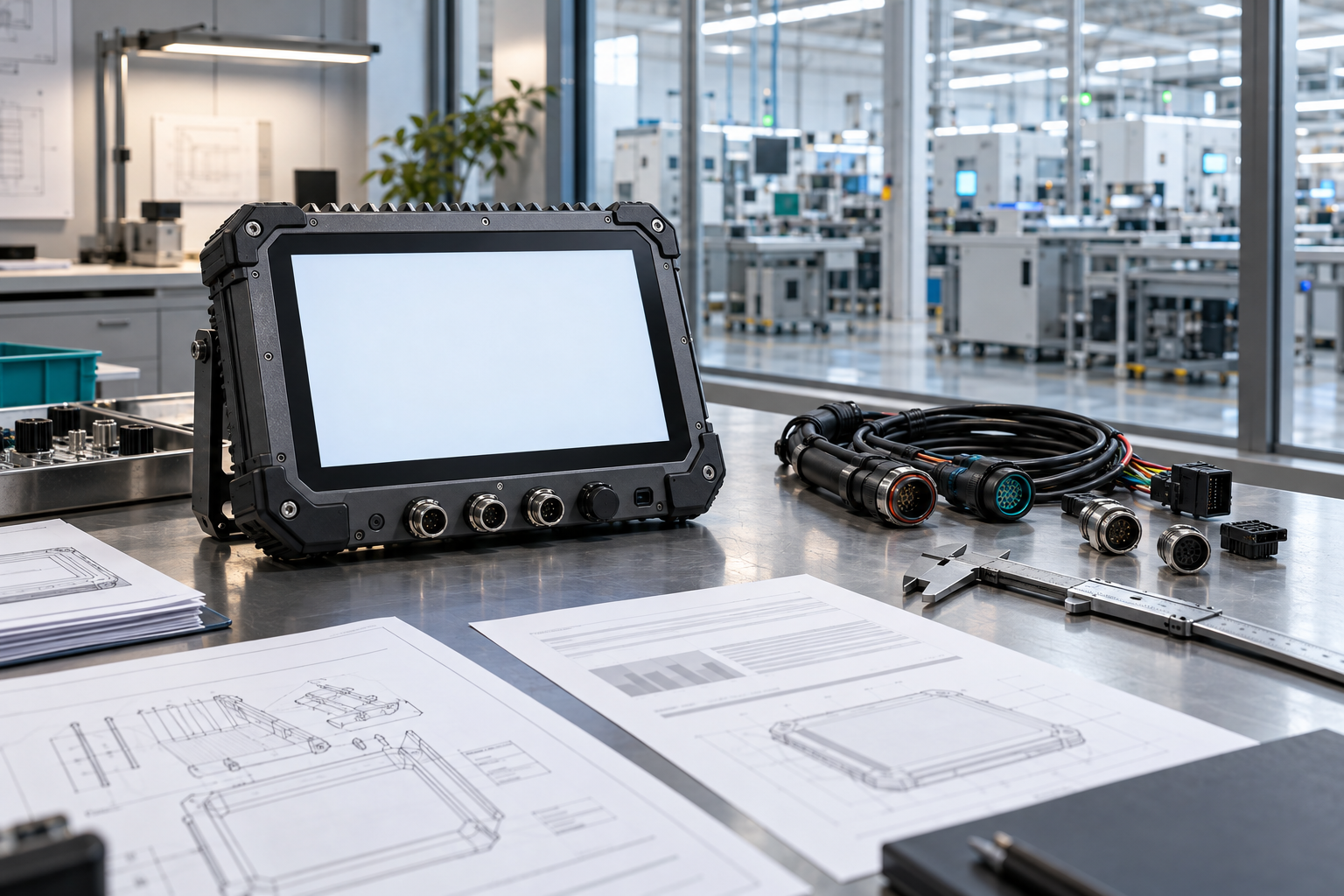
This RTK GNSS terminal buyer guide is written for equipment manufacturers, system integrators, fleet technology teams, and procurement staff who need a terminal that will be installed for years rather than demonstrated for a day. The key decision is not simply which receiver claims the smallest accuracy number. It is whether the complete terminal, correction link, antennas, software, vehicle interfaces, and supplier support can meet an agreed field test.
A useful purchase process starts with a one-page requirement sheet, reduces the market to two or three viable configurations, and finishes with a pilot on the real vehicle. That process also makes supplier quotations easier to compare because every vendor is answering the same technical questions. Used this way, an RTK GNSS terminal buyer guide becomes a working procurement document rather than general background reading.
1. Write buyer requirements before requesting a price
Begin with the work the vehicle performs. “We need RTK” is not enough. A tractor auto-steering system, a grading display, a construction machine location terminal, and a mapping vehicle may all use high-precision GNSS, but they do not share the same screen, interfaces, correction service, update rate, or safety response.
Record the following points before contacting a manufacturer:
- vehicle type, electrical system, cab drawing, and mounting space;
- required horizontal and vertical performance, repeatability, and update rate;
- working region, expected sky obstruction, and antenna location;
- correction source: network RTK, local base, UHF radio, or customer platform;
- application owner, operating system, boot behavior, and update method;
- CAN, RS232, RS485, Ethernet, USB, GPIO, camera, and wireless requirements;
- display size, brightness, touch or button operation, and operator reach;
- pilot quantity, annual forecast, customization, certifications, and delivery plan.
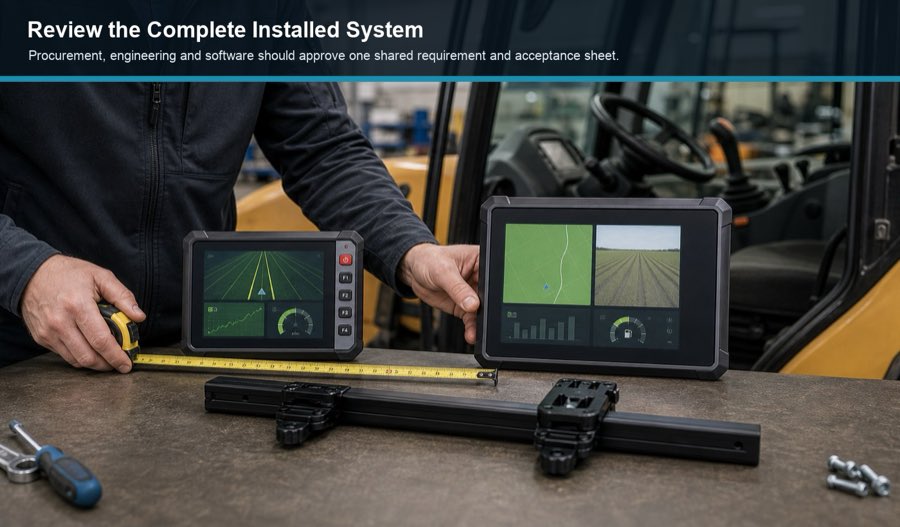
2. Separate positioning accuracy from positioning availability
RTK can provide centimeter-level results, but only after the system receives suitable satellite measurements and correction data and resolves a high-precision solution. The u-blox high-precision positioning overview describes RTK as a combination of carrier-phase measurements, correction data, algorithms, and receiver hardware. That is why a buyer should ask more than “What is the accuracy?”
Ask how long the system normally takes to reach an RTK fixed state, how it reports float or standalone states, what happens after correction loss, and how quickly it recovers. Then put those behaviors into the pilot acceptance sheet. A terminal that briefly reaches a good number in an open parking lot may still be unsuitable beside tree lines, buildings, conveyors, or mine walls.
3. Confirm the correction service and data path
The correction source is a recurring operating dependency. Network RTK requires coverage, a compatible data format, credentials, and a stable data connection. A local base station requires installation, survey coordinates, radio or network equipment, maintenance, and regulatory checks. Some operations use both network and radio paths for different regions.
Government reference networks illustrate the role of reliable reference data. The GPS.gov augmentation overview notes that augmentation systems improve accuracy, integrity, availability, or other aspects of positioning. The commercial service chosen for a production vehicle should be checked for actual coverage, latency, supported protocols, service-level terms, and annual cost in the destination market.
4. Treat the antenna as a system component
A premium receiver connected to a poor antenna installation will not behave like the brochure. Confirm the antenna type, connector, cable length, cable loss, mounting thread, ground-plane requirement, environmental sealing, and separation from radios or other sources of interference. For dual-antenna heading, also confirm baseline length, orientation, and calibration.
Ask the supplier to mark antenna ports and cable part numbers on the quotation. If the cable is supplied by another party, assign responsibility for final compatibility. A surprising number of field problems begin with a connector adapter, a damaged cable, or an antenna installed where the cab reflects satellite signals.
5. Compare ruggedness using evidence, not adjectives
“Industrial,” “rugged,” and “vehicle-grade” are useful category labels, but they are not test reports. Request the exact ingress rating, operating temperature, vibration or shock reference, connector sealing design, and vehicle-power protection that apply to the proposed configuration. Check whether the evidence covers the complete terminal or only a component.
Vehicle power deserves its own review. The device may see engine cranking, load changes, ignition cycling, incorrect wiring, and a battery that must not be drained after shutdown. Confirm input range, ACC wiring, fuse, reverse-polarity protection, surge behavior, shutdown delay, and the application response when power is removed.
6. Match the display and interfaces to the operator's day
A 7-inch screen can be correct for a compact cab and a focused guidance interface. A 12-inch screen may be justified when guidance, machine status, alarms, and several camera views must remain visible together. Screen size should be reviewed with application screenshots at the intended viewing distance. Brightness, optical bonding, reflections, gloves, physical buttons, and mounting reach matter more than diagonal size alone.
For interfaces, count functions rather than connector names. Two CAN channels can still be wrong if the required bitrate, isolation, termination, message ownership, or driver is missing. Apply the same rule to cameras, RS232, RS485, Ethernet, GPIO, USB, GNSS output, and radio interfaces. Ask for the pinout and development documentation before the software schedule is fixed.
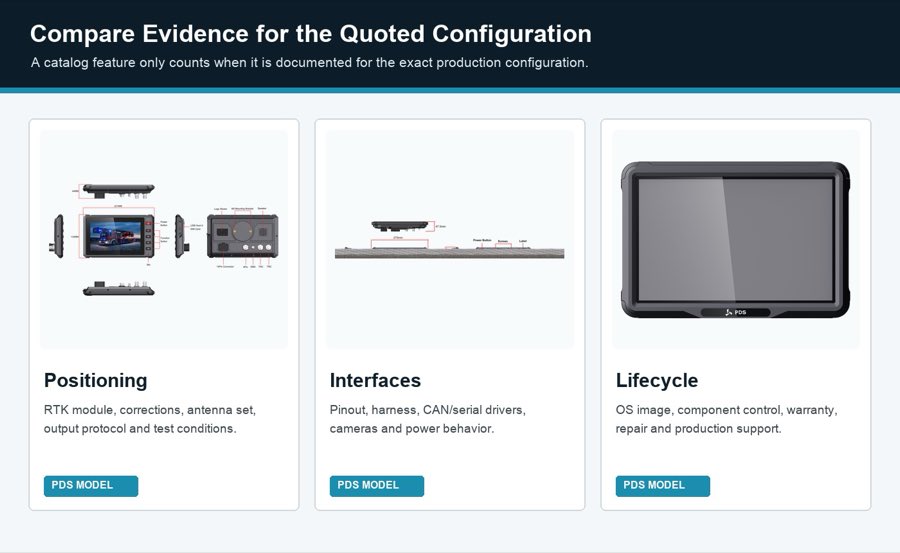
7. Shortlist PDS configurations by project type
| Project starting point | PDS model to review | Why it belongs on the shortlist |
|---|---|---|
| Compact tractor or narrow cab | T7 | 7-inch format, front function keys, Android/Linux options, optional UM982 RTK, 9-36V DC, IP66 |
| Android application with RTK, cameras, or radio corrections | T10Pro | 10.1-inch display, Android 11/13, optional UM482/UM982 RTK and 410-470 MHz radio, camera and CAN/serial interfaces |
| Large HMI for agriculture or heavy equipment | T12 | 12.1-inch screen, Android/Linux option, optional RTK, dual CAN, serial, Ethernet, GPIO, and four camera ports |
PDS Technology supports OEM/ODM work, but customization should begin after the standard configuration is understood. Changing an enclosure, harness, logo, connector, firmware image, or interface combination can affect tooling, validation, certification, minimum order quantity, and lead time. Put each requested change into the quotation rather than relying on meeting notes.
8. Use one supplier comparison checklist
| Area | Document or answer to request | Common purchasing risk |
|---|---|---|
| Exact configuration | Model code, BOM options, OS image, receiver and modem | Sample and mass-production units differ |
| Positioning | RTK module, protocols, outputs, antennas, test conditions | Accuracy claim is not reproducible |
| Correction path | Network/radio hardware, frequencies, service responsibility | Terminal arrives without a usable correction source |
| Interfaces | Pinout, cable drawing, drivers, API/SDK, sample code | Logical port exists but cannot connect to the machine |
| Reliability | Test reports and conditions for the quoted unit | Marketing rating is assumed to cover the whole design |
| Lifecycle | Component-change notice, software support, repair and warranty | Unexpected redesign after the pilot |
| Production | MOQ, sample lead time, production lead time, traceability | Commercial plan does not match the rollout schedule |
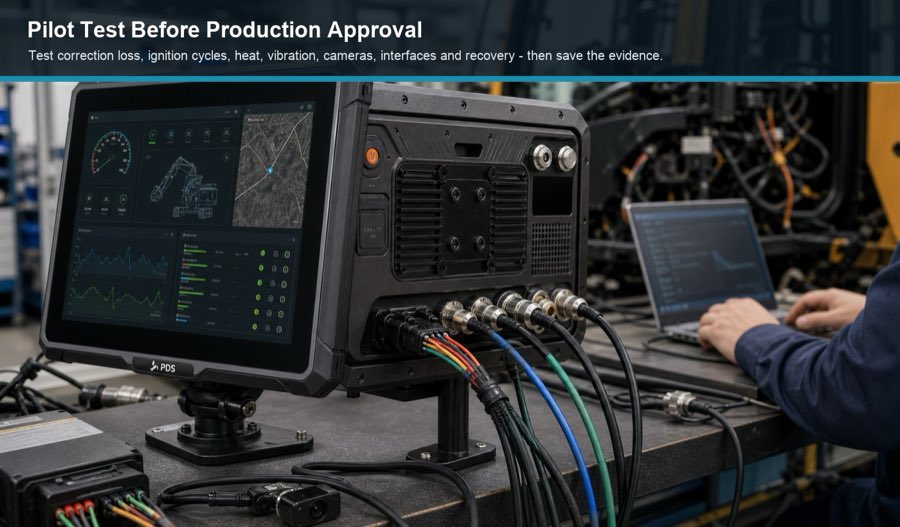
9. Make the pilot test difficult on purpose
The pilot should recreate the inconvenient parts of a working season. Start the engine repeatedly. Let the terminal heat up in direct sun. Move near buildings and trees. Interrupt correction data, 4G service, and a camera. Disconnect a CAN device. Turn off the ignition while data is being written. Check whether the application preserves work, tells the operator what happened, and recovers without a technician.
Measure initialization time, fixed-solution availability, repeat-pass error, screen readability, touch response, boot time, current draw, network recovery, data loss, and connector stability. Use the same test sheet for every shortlisted product. Photographs, logs, firmware versions, antenna positions, and wiring drawings should be saved with the result.
10. Compare total project cost, not only unit price
The lowest terminal price can become expensive if the project later needs a new harness, external modem, correction radio, display, enclosure, or custom driver. Include antennas, brackets, cables, SIM and correction subscriptions, software integration, certification, installation labor, spare units, warranty return freight, and future component changes.
Also assign responsibility. Who configures the receiver? Who supplies correction credentials? Who maintains the application? Who supports the driver when a CAN message changes? Who approves an OS update? Clear ownership reduces delays more effectively than a long feature list.
Frequently asked questions
Should an RTK terminal buyer always request the highest update rate?
No. The required rate depends on vehicle speed, control loop, application, communications, and controller design. A higher number may add load without improving the working result. Ask the system engineer to specify the necessary rate and test it end to end.
Is IP66 enough for every outdoor vehicle?
No single rating covers every installation. IP66 addresses dust and water ingress under defined test conditions, but buyers must also consider temperature, vibration, chemicals, pressure washing, connector exposure, mounting, and cable sealing.
When should OEM/ODM work begin?
Begin after the target workflow and standard platform have been validated. Early cosmetic or connector changes can hide more important positioning, software, and reliability risks. Freeze the customized specification before tooling or mass production.
What is the best first message to an RTK GNSS terminal manufacturer?
Send the requirement sheet: application, vehicle, accuracy, corrections, screen, OS, interfaces, cameras, power, environment, installation drawing, market, pilot quantity, annual volume, and target date. That information allows a manufacturer to recommend a real configuration instead of a generic catalog item.
Turn the buyer guide into an acceptance plan
The strongest use of an RTK GNSS terminal buyer guide is not reading it once. Convert the requirements, supplier evidence, and field tests into a project record that engineering and purchasing can both approve. The selected terminal should earn its place by meeting the operating result on the target vehicle.
Browse the PDS vehicle terminal range, review the precision agriculture solution, or contact PDS Technology to discuss an RTK GNSS terminal, harness, software, or OEM/ODM configuration.
Contact us
📧Email:[email protected]
📞Tel:+86 13421822024
🌐Website: www.szpds.com
Disclaimer
The information in this article is for reference only. PDS Technology Co., Ltd. assumes no responsibility for errors, omissions, or suitability of the content for specific applications. Product specifications are subject to change without notice. Buyers should verify all technical details with our team before use.
About PDS Technology
PDS Technology is a leading OEM/ODM manufacturer of high-precision RTK GNSS terminals and vehicle computers, serving agriculture, construction, mining, taxi, and logistics industries since 2011.
With 15+ years of automotive-grade R&D experience, we offer rugged, multi-OS (Android/Linux/OpenHarmony) devices featuring RTK centimeter-level positioning, IP66 protection, and AI-ready performance. Our IATF16949-certified factories have produced over 100,000 units deployed globally, holding 30%+ of China's agricultural auto-steering terminal market. We export to Japan, the US, UK, Turkey, Russia, and beyond.