A rugged vehicle terminal OEM checklist should function as a set of approval gates. First define the vehicle and operator task; then freeze the display, interfaces, power, radios, enclosure and software; finally prove the installed build in a pilot. Checking boxes against a brochure is not enough because the terminal, harness, bracket, antenna and application behave as one system on the vehicle.
Use the checklist below for early supplier screening and again before production release. Record a document or test result beside each answer. “Supported” should never be the end of a row: identify the port, connector, protocol, option code, software build and acceptance condition that make the statement true.
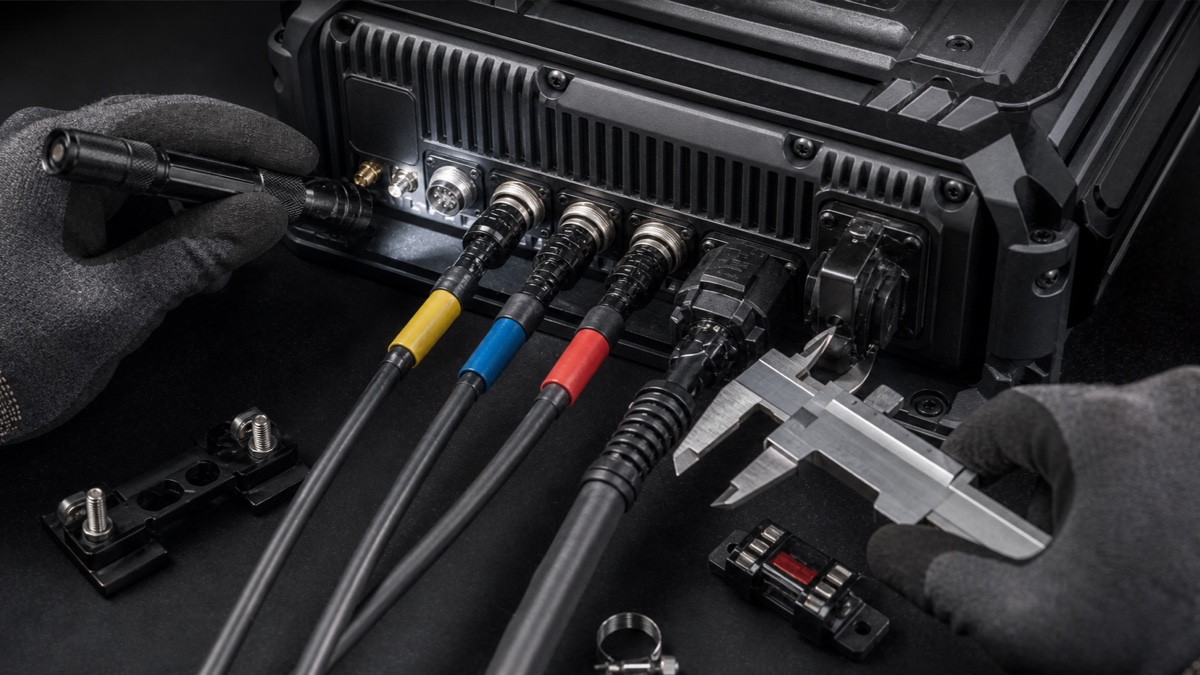
Connector placement, strain relief and cable service space should be reviewed with the terminal drawing, not after the first vehicle arrives for installation.
Gate 1: define the operator and installation
Write one page describing the vehicle, working surface, shift length, mounting location and operator actions. Note whether the screen sits in direct sun, whether gloves are used, how often the cab is cleaned and what could strike the unit. Measure the available envelope and the viewing distance. A 7 inch rugged vehicle terminal can suit a tight console, while an 8 inch rugged vehicle terminal may offer a different balance of viewing area and installation space. The correct choice depends on the interface layout and cab, not the nominal diagonal alone.
List every item included in the installed assembly: terminal, bracket, fasteners, power lead, data harness, antennas, protective caps and any converter. Assign responsibility for each item. This simple step prevents a gap in which the device supplier assumes the integrator will seal a connector while the integrator assumes the cable is already protected.
Gate 2: freeze electrical and communication requirements
Power input and ignition behavior
Measure voltage at the proposed connection during crank, idle, charging and operation of large accessories. Define fuse position, grounding, reverse-polarity expectations and the desired ignition-on and delayed-shutdown behavior. Ask the OEM to state the input limits and protection conditions for the exact hardware revision. A nominal “12/24 V” label does not describe every disturbance on a working machine.
Ports, protocols and pinouts
Create a signal table for CAN, RS232, RS485, USB, Ethernet, digital I/O, camera input and audio where required. State baud rates, termination, isolation expectations, connector family and mating part. For CAN, name the higher-layer protocol or message ownership rather than writing only “CAN Bus.” Require an approved pinout drawing and a labeled cable sample before the pilot.
4G LTE, Wi-Fi, Bluetooth and GNSS
A rugged vehicle terminal with 4G LTE must be reviewed for the countries, carriers, bands, SIM arrangement, antenna location and fallback behavior in the project. Define what the application does when coverage disappears and how buffered data is recovered. Wireless module options and approvals can differ by configuration, so ask for current documentation tied to the destination market. Apply the same discipline to Wi-Fi, Bluetooth and GNSS options.
Gate 3: review environmental evidence
| Checklist item | Evidence | Pilot check |
|---|---|---|
| Dust and water | Rating, method, sample and connector state | Inspect the complete installed seal and cable route |
| Temperature | Operating and storage limits for the quoted build | Start, operate and shut down at representative extremes |
| Vibration and shock | Test profile, axes, duration, mount and pass criteria | Drive the actual route and recheck fasteners and ports |
| Display | Brightness, touch and optical configuration | Check sun, shade, night dimming and glove input |
| Chemical exposure | Material and cleaning guidance | Use the approved cleaning process on a sample |
Do not convert an enclosure rating into a promise about the whole installation. An unused port, damaged gasket, unsealed antenna connection or incorrectly assembled cable can change the result. Ask the OEM to show which caps, plugs and mating connectors were present during testing.
Gate 4: control software and cybersecurity basics
Record the operating system, kernel or BSP where relevant, application version, device configuration and update method. Decide who signs and releases software, how a failed update is recovered and how production units receive the approved image. If remote management is required, define enrollment, credentials, access roles, logging and decommissioning. These are project requirements, not assumptions that can be added after shipment.
Run a power-interruption test while the application writes data. Confirm boot time, data integrity, peripheral reconnection and behavior after a network outage. Keep the accepted software hash or build identifier with the pilot record so later units can be checked against it.
Gate 5: confirm production and change control
Ask how the OEM converts an approved sample into repeatable production. The release pack should identify the terminal revision, bill of materials, connector drawing, cable drawing, bracket, labels, packaging, software image and final-test method. Where calibration or device-specific credentials are involved, define how they are created, protected and linked to the serial number.
Review the supplier's treatment of nonconforming material. Who can authorize rework? Is the repaired unit put through the complete final test? Can a rejected modem, display or cable accidentally return to normal stock? A short walkthrough of one recent, anonymized quality case can show whether the process is used in practice.
Agree on change notification before placing the volume order. The notice should describe the old and new parts, reason, affected functions, validation performed, timing and last-buy implications where relevant. The buyer should know which changes require written approval. Add this requirement to the purchase specification instead of relying on an informal sales promise.
Gate 6: install and observe a pilot

A pilot is an installation exercise as much as a device test. Check the operator's reach and sight line, cable movement, antenna clearance and access for service.
Use representative vehicles rather than the cleanest demonstration unit. Run the normal shift, record connection drops, inspect thermal behavior and ask operators which actions are slow or error-prone. Repeat ignition cycles and deliberately remove network coverage. At the end, inspect brackets, connectors and cable supports before approving the mechanical package.
Close every pilot issue with an owner, due date and verification result. If a cable, enclosure or software image changes, decide which tests must be repeated. Production release should reference the approved drawings, bill of materials, firmware, application and final inspection plan.
Build a receiving check for volume shipments
The buyer's receiving team should be able to verify identity without repeating the full design validation. Check carton and unit labels, quantities, visible damage, accessory presence and the configured hardware or software code. Sample functional checks can cover boot, touch, key ports and wireless identity according to the agreed inspection plan. Keep a golden unit and approved drawings available for comparison.
Retain dated inspection photos and results by shipment so a later field issue can be traced to the received lot and configuration.
When a mismatch appears, quarantine the affected lot and record photographs, serial numbers and package labels before changing anything. That evidence lets the OEM trace the build and prevents a correctable labeling issue from being confused with a technical failure.
Applying the checklist to PDS products
PDS Technology provides vehicle-mounted computers and RTK GNSS terminals with project-based OEM/ODM options. The T7 and T8 are useful starting points when comparing compact display sizes, while the T10 and T12 can be considered where a larger interface is needed. Model availability, LTE bands, ports, sealing, display options and operating-system support must be verified against the current PDS quotation.
Send PDS the completed rugged vehicle terminal OEM checklist with drawings and field conditions. Ask the team to mark each line as standard, configurable, custom or unavailable and to name the supporting document. That creates a clear technical baseline for a sample request and avoids choosing a model by screen size alone.
FAQs
Should a buyer choose a 7 inch or 8 inch rugged vehicle terminal?
Compare the actual active area, resolution, viewing distance, touch targets, cab envelope and connector clearance. Test the intended interface on the mounted sample before deciding.
What must be checked for a 4G LTE terminal?
Confirm destination countries, bands, carriers, SIM design, antenna placement, approvals and application behavior during weak or lost coverage for the exact modem option.
When is an OEM pilot complete?
It is complete when planned use cases have passed, issues are closed or formally accepted, and the approved hardware, cable, software and inspection revisions are recorded.
Contact us
📧Email: [email protected]
📞Tel: +86 13421822024
🌐Website: www.szpds.com
Disclaimer
The information in this article is for reference only. PDS Technology Co., Ltd. assumes no responsibility for errors, omissions, or suitability of the content for specific applications. Product specifications are subject to change without notice. Buyers should verify all technical details with our team before use.
About PDS Technology
PDS Technology is a leading OEM/ODM manufacturer of high-precision RTK GNSS terminals and vehicle computers, serving agriculture, construction, mining, taxi, and logistics industries since 2011.
With 15+ years of automotive-grade R&D experience, we offer rugged, multi-OS (Android/Linux/OpenHarmony) devices featuring RTK centimeter-level positioning, IP66 protection, and AI-ready performance. Our IATF16949-certified factories have produced over 100,000 units deployed globally, holding 30%+ of China's agricultural auto-steering terminal market. We export to Japan, the US, UK, Turkey, Russia, and beyond.