A rugged GNSS terminal supplier checklist should test the whole positioning chain: satellites, antenna, receiver, correction source, communication link, vehicle interfaces, software and installation. A receiver may report an impressive accuracy figure under favorable conditions, yet the installed system can still disappoint beside trees, buildings, metal structures or radio dead zones. Buy against defined operating cases and measurable acceptance criteria.
Start by writing what the vehicle must do with position data. Guidance, mapping, lane-level tracking and machine control do not have the same tolerance for error, latency or loss of corrections. State the geography, terrain, sky visibility, speeds, duty cycle and time allowed to recover after an interruption. The rugged GNSS terminal supplier can then propose a configuration without hiding critical assumptions.
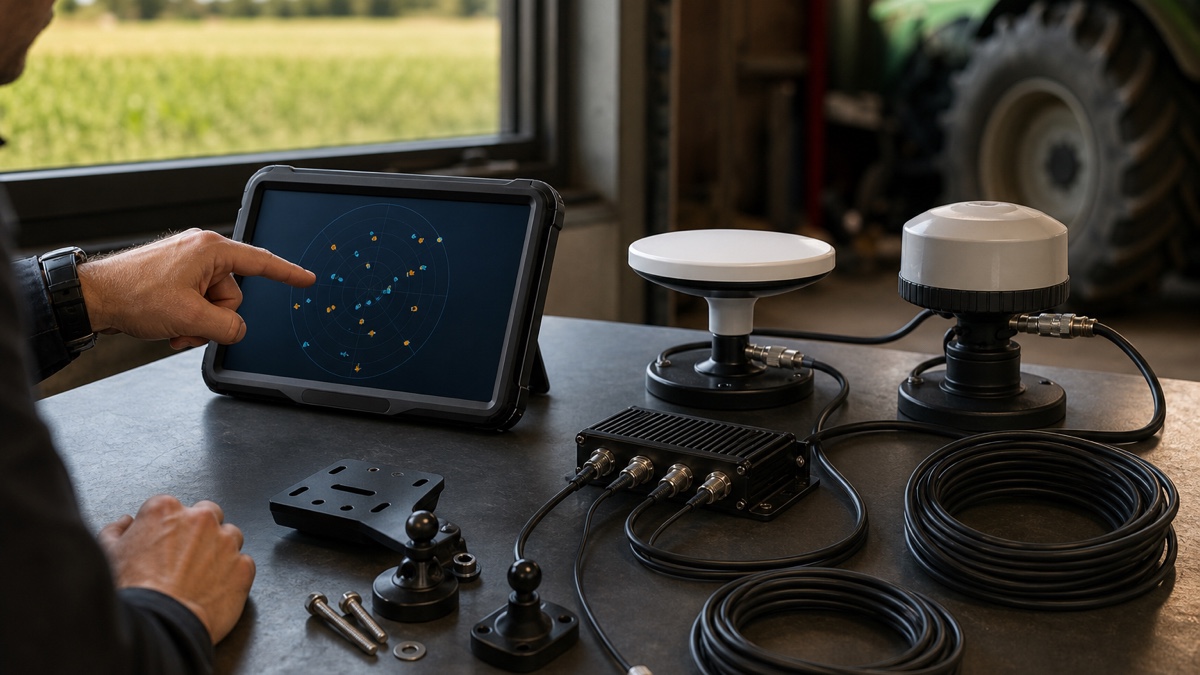
Review the terminal, antenna, cable, correction link and mounting hardware as one kit. Substituting any one of them can change field results.
1. Define positioning performance in context
Avoid a single accuracy number without a probability, test duration and environment. Ask how horizontal and vertical error are stated, whether the result is repeatable, what correction age was present and how long the system had been operating. The U.S. government’s GPS accuracy guidance notes that geometry, signal blockage, atmospheric conditions and receiver design affect performance. Your acceptance plan should therefore include both open-sky reference work and the obstructed areas the vehicle actually encounters.
For RTK, define the required solution state, time to reach it, age of correction, tolerated outage and recovery time. Decide what the machine should do when the solution degrades. A safe application may warn the operator or pause an automated action instead of continuing with stale confidence. The terminal must expose enough status information for the application and service team to make that decision.
2. Check constellations, frequencies and correction delivery
Receiver configuration
Ask the supplier to identify the receiver option, supported constellations and frequencies, update rate, output messages and firmware revision for the offered build. More signals can improve availability, but the result still depends on antenna quality, installation and the algorithms in use. Confirm which outputs the application consumes and who controls receiver settings in production.
Correction source and communications
Document whether corrections arrive through NTRIP over cellular, a local radio, another network or a project-specific source. Confirm message formats, credentials, data use, roaming, radio rules and coverage. Test deliberate outages and record how the system reports correction loss, how long it retains a usable state and how it reconnects. A 4G modem specification is not a coverage guarantee.
3. Treat antenna installation as engineering work
The antenna needs a clear view of the sky and a mechanically stable relationship to the vehicle reference point. Nearby metal, roof shape, hydraulic equipment, radios and moving implements can affect reception or multipath. Define the antenna model, ground-plane needs, orientation, mounting hardware, cable type, maximum length and connector sealing. Keep GNSS and transmitting antennas separated according to the approved design.
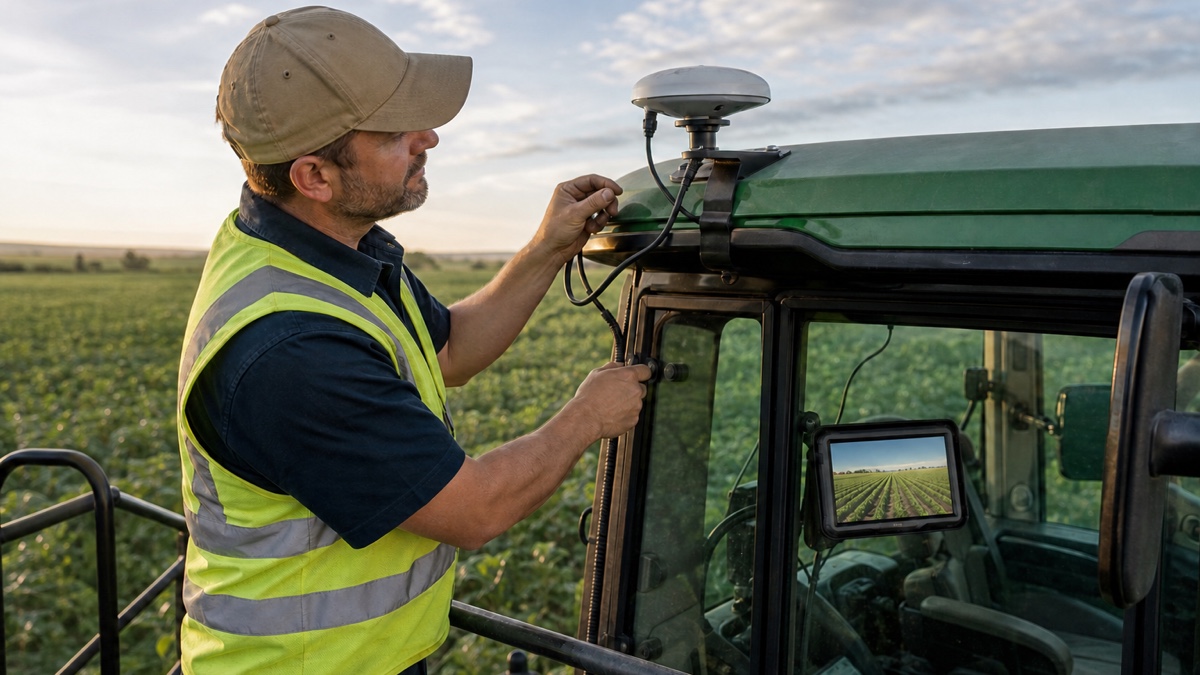
Record antenna location and cable routing during acceptance. A later production change can then be compared with the field-approved installation.
4. Verify vehicle integration and ruggedness
Create a signal map for CAN, serial, Ethernet, USB, digital I/O and any camera or sensor data used by the application. Specify connector and pin assignments, message ownership, baud rates, isolation and termination. If heading or motion data comes from an IMU, define alignment, calibration and how the application detects invalid data. An RTK GNSS rugged vehicle terminal should also be assessed for power interruptions, grounding, electromagnetic interference and safe shutdown on the target machine.
For dust, water, temperature, vibration and shock claims, request the method, sample configuration and pass criteria. Check that the report covers the connector state and mounting arrangement you will use. The enclosure rating does not automatically extend to a loose mating plug, damaged antenna cable or customer-supplied gland.
Supplier evidence and field acceptance table
| Decision area | Supplier evidence | Buyer acceptance |
|---|---|---|
| Position solution | Receiver configuration, outputs and stated conditions | Reference route with logged truth or surveyed points |
| RTK corrections | Supported format, link design and status reporting | Outage, reconnection and recovery test |
| Antenna system | Antenna, cable, connector and installation guidance | Approved location, route and interference check |
| Vehicle data | Pinout, protocol and message documentation | End-to-end application data test |
| Diagnostics | Logs, status fields and service workflow | Reproduce and diagnose injected faults |
| Production control | Revision, calibration and final-test records | Compare a production sample with the approved pilot |
5. Demand usable diagnostics and traceability
Service teams need more than latitude and longitude. Ask which status fields and logs expose satellite use, solution state, correction age, communication loss, antenna faults, supply events and software versions. Decide how logs are collected without removing the terminal from service. A field report should identify the terminal serial number, receiver firmware, application build, antenna, correction source and vehicle.
Traceability should continue into production. Confirm how the supplier records hardware revisions, calibrated items, software images and final tests. Ask how a component change is notified and what regression work follows. This matters because two units with the same enclosure can behave differently if the receiver, modem, antenna or firmware changes.
Questions that expose an incomplete proposal
Ask the candidate to draw the data path from antenna to application and label every supplier, cable, protocol and network dependency. Then ask what the operator sees when each link fails. If the answer covers only normal operation, fault handling is not finished. Request a sample log for an antenna disconnect, expired correction credential, cellular outage and low supply event.
Clarify what must be provided by the buyer: local SIM, correction subscription, surveyed base position, vehicle messages, mounting plate or calibration procedure. Put those dependencies in the proposal. Also ask which performance statements depend on a particular antenna or paid service. This prevents an attractive terminal price from excluding a necessary part of the working system.
Finally, give the supplier two difficult field cases and request a reasoned response. For example, use a machine that works beside a tree line and a fleet that crosses cellular boundaries. A credible response will identify limits and propose a test; an incomplete one will repeat the headline accuracy figure.
6. Pilot on routes that can expose weakness
Build a route with open sky, turns, stops, slopes and representative obstructions. Log raw status alongside the application output and an independent reference where practical. Repeat at different times instead of relying on one favorable pass. Include cold start, warm restart, correction loss, cellular handover, ignition cycles and a short power interruption. The pass criteria should state how many runs, which percentiles or maximum errors matter and which failure states are unacceptable.
Keep the accepted antenna location, cable, bracket, configuration and software unchanged for the production baseline. If the vehicle roof or implement differs across the fleet, sample those variants. A rugged GNSS terminal supplier checklist is complete only when the installed system meets the intended task, not when the receiver produces a fix on a bench.
Preserve a field test record that others can repeat
The report should include date, route, weather, vehicle, reference method, antenna photograph, cable route, terminal serial number, hardware and firmware revisions, correction source and application build. Save the raw log as well as summary charts. A pass/fail statement without those details is hard to investigate and almost impossible to reproduce a year later.
Record anomalies even when the overall run passes. A brief loss of correction near one obstruction may matter more than the average error across an hour of open sky. Link each anomaly to time and location, then decide whether it reflects a known operating limit, an installation change or a defect that requires supplier action.
Evaluating PDS Technology as the supplier
PDS Technology develops rugged vehicle computers and RTK GNSS terminals for applications including precision agriculture and agricultural auto-steering. Buyers should provide the vehicle, accuracy goal, correction source, antenna constraints, interfaces and operating environment. PDS can then map the requirement to a standard platform or an OEM/ODM configuration.
Before selection, request the current datasheet, option list, drawings and validation evidence for the exact quoted PDS build. Agree on a field acceptance plan and the records required at production release. This keeps the discussion tied to the buyer's application instead of assuming that every GNSS option, radio or environmental claim applies to every model.
FAQs
What is the most important item in an RTK GNSS terminal buyer guide?
Define the field acceptance conditions first. Accuracy, fix state and recovery time only have meaning when the route, antenna, correction link and reference method are recorded.
Can open-sky accuracy prove performance for every route?
No. Open sky is a useful baseline, but buildings, trees, terrain, interference and antenna placement can change results. Test representative obstructed areas as well.
What should be frozen after the GNSS pilot?
Freeze the terminal and receiver revisions, firmware, antenna, cable, mount, correction configuration, application build and relevant vehicle installation details.
Contact us
📧Email: [email protected]
📞Tel: +86 13421822024
🌐Website: www.szpds.com
Disclaimer
The information in this article is for reference only. PDS Technology Co., Ltd. assumes no responsibility for errors, omissions, or suitability of the content for specific applications. Product specifications are subject to change without notice. Buyers should verify all technical details with our team before use.
About PDS Technology
PDS Technology is a leading OEM/ODM manufacturer of high-precision RTK GNSS terminals and vehicle computers, serving agriculture, construction, mining, taxi, and logistics industries since 2011.
With 15+ years of automotive-grade R&D experience, we offer rugged, multi-OS (Android/Linux/OpenHarmony) devices featuring RTK centimeter-level positioning, IP66 protection, and AI-ready performance. Our IATF16949-certified factories have produced over 100,000 units deployed globally, holding 30%+ of China's agricultural auto-steering terminal market. We export to Japan, the US, UK, Turkey, Russia, and beyond.