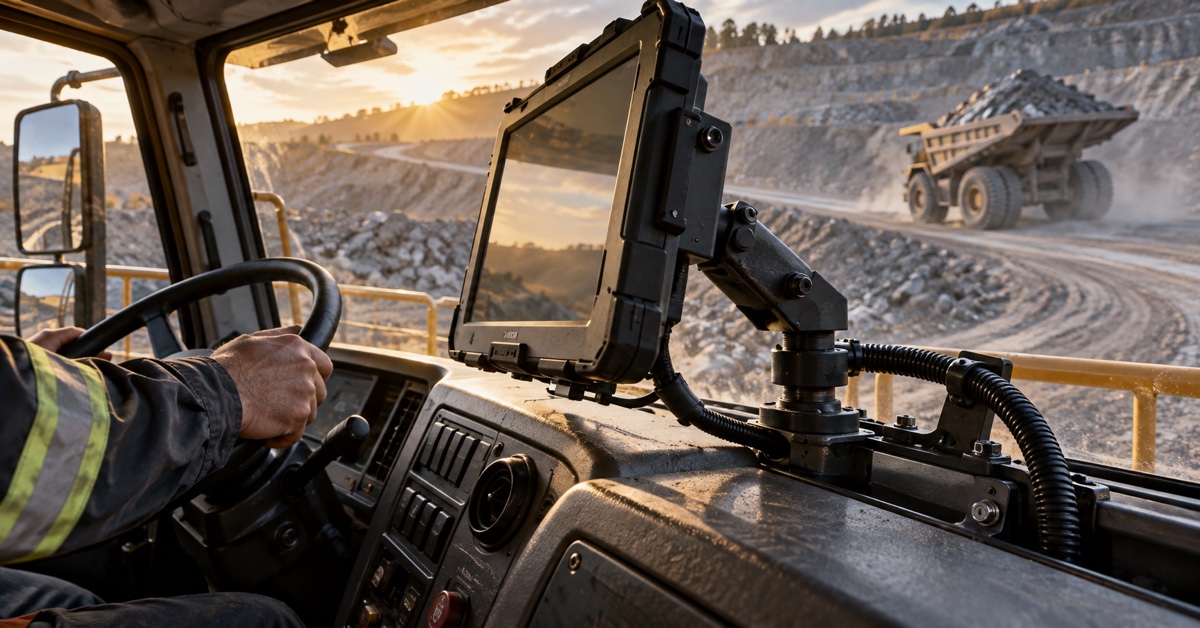
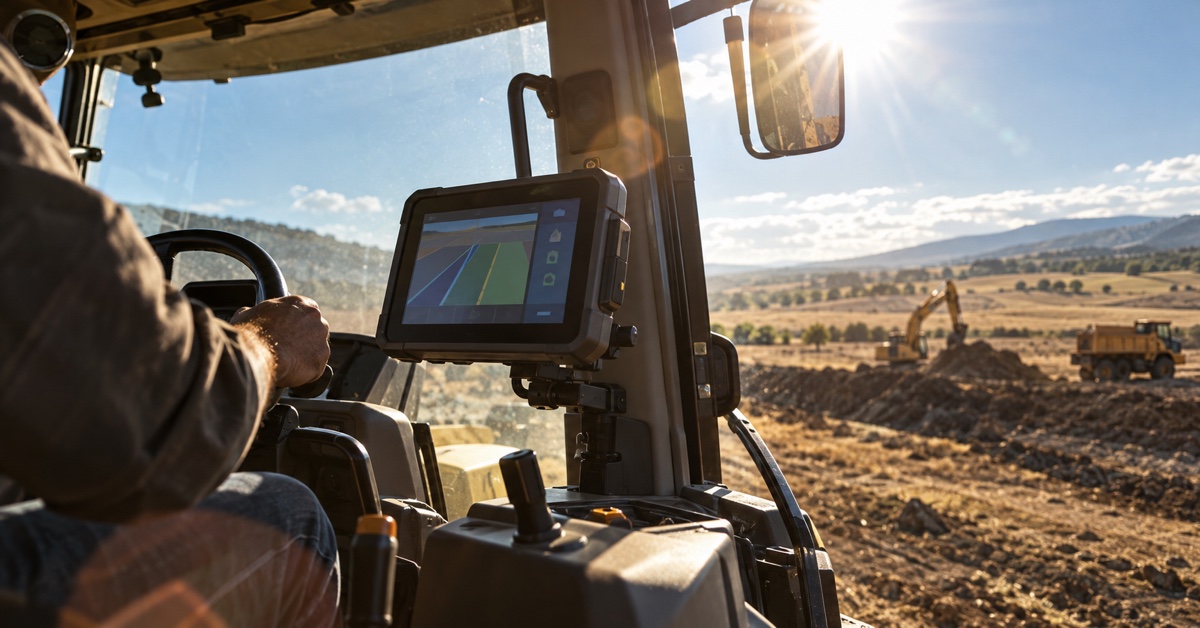
A vehicle terminal sees a power system that is less tidy than a laboratory supply. Battery voltage changes with engine state, alternator activity, starting and accessory loads. At the same time, the mounting point can experience repeated vibration, shocks and resonance from the vehicle frame. A wide-voltage vehicle computer must be selected together with its harness, fuse, bracket and software shutdown behavior.
The goal is not to make an unrealistic promise that one device works in every vehicle. The goal is to define the supply range, transient conditions, vibration exposure and mounting method for the target machine, then check that the quoted PDS configuration fits those conditions. This is especially important for agricultural equipment, construction machinery, mining trucks, yard vehicles and service fleets.
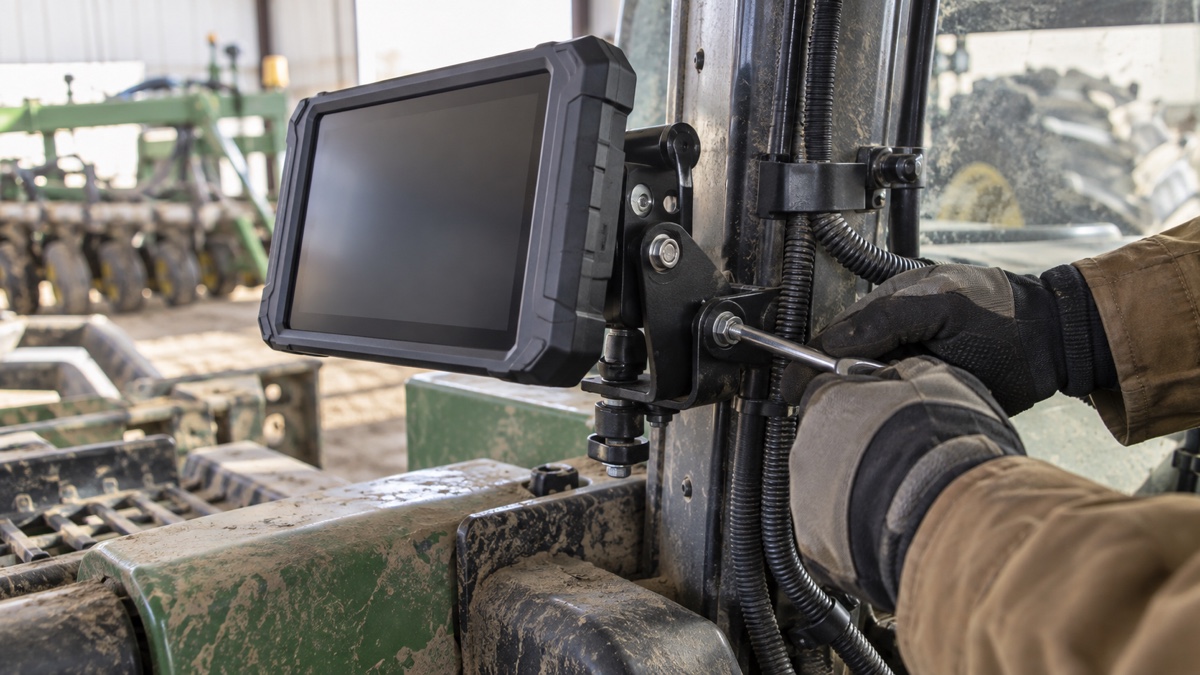
Heavy-equipment installation illustration. The terminal, bracket and cable path must be evaluated as one mechanical and electrical assembly.
Why voltage and vibration belong in one review
A nominal battery label is not the whole supply
A vehicle described as 12 V or 24 V still has a range of operating conditions. Starting can pull the supply down. Charging can raise it. Solenoids, motors and relays can create short disturbances. Before choosing a wide voltage vehicle computer, capture the actual supply at the proposed terminal location during start, normal running and accessory switching.
Vibration reaches the connector first
A rigid computer may survive a vibration environment while a heavy cable pulls on its connector or a loose bracket amplifies movement. Cable support, strain relief, fastener locking and bracket stiffness should be included in the design. The display should remain readable and touch input should remain predictable after the vehicle has accumulated real operating hours.
Protection must be matched to the machine
Input protection, filtering and a fuse can reduce risk, but they do not excuse incorrect wiring. Put the protective device near the supply source, use the specified cable size and provide a controlled ground path. If the terminal is installed outside a cab, review its IP66 vehicle mounted computer option and the sealing of every exposed connection.
Selection checklist for harsh vehicle duty
| Design area | What to define | How to validate |
|---|---|---|
| Input power | Nominal system, low and high operating points, start event | Measure at the terminal with a data logger |
| Harness | Fuse, cable gauge, ground, routing and strain relief | Inspect the installed route and repeat ignition tests |
| Mount | Bracket stiffness, fasteners, resonance and service access | Run the machine on the actual surface and inspect movement |
| Environment | Dust, water, sun, temperature and cleaning method | Compare with the specified PDS configuration |
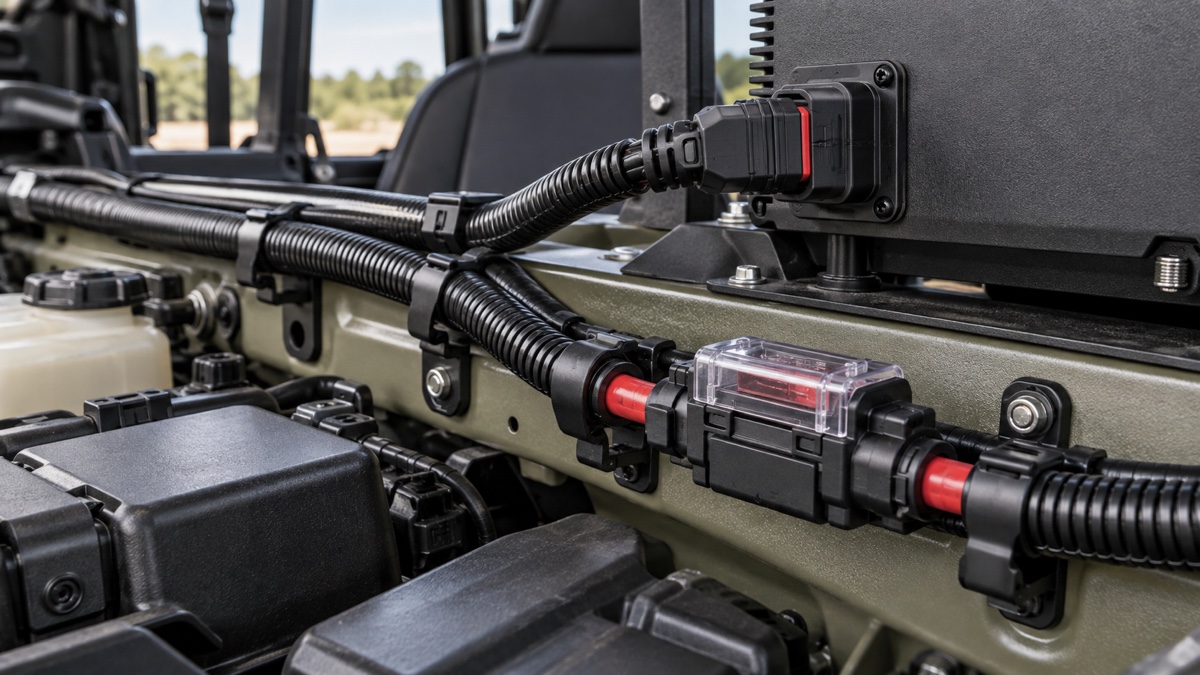
Power-harness detail illustration. Connector locking, fuse position and cable support should be visible in the installation record.
Mounting a vibration-resistant vehicle terminal
Start with the machine's vibration source and the operator's sight line. A bracket that is too flexible can shake the image; one that is too rigid can transfer a sharp shock into the enclosure. Use the supplier's mounting points, keep heavy cables supported, and leave room for connector service without bending the cable at its minimum radius.
Do not use soft isolation mounts without checking their stiffness and resonance. The same mount can be helpful at one frequency and harmful at another. After installation, inspect fasteners, cable clamps and connector backshells at the first service interval and after the machine has completed a representative duty cycle.
PDS product and configuration review
PDS supplies rugged vehicle computers and terminals for equipment that may need GNSS, CAN Bus, serial ports, cameras, 4G LTE and multi-OS software. Product families such as the T8, T10 and T12 can be reviewed by screen size and interface needs. Confirm the input range, protection, mounting hardware, connector type and environmental options for the exact quote.
A sunlight readable vehicle computer may be appropriate when the operator works outside, while an IP66 vehicle mounted computer may be necessary where dust and washdown are part of the duty cycle. These features solve different problems. PDS can review the power profile, mounting drawing and application requirements together so the final configuration is testable.
Commissioning tests that reveal weak points
Record the supply while the machine starts, idles, accelerates and switches its largest loads. Check that the terminal boots consistently and shuts down safely. Then run the vehicle on the actual route or work surface while logging display movement, connector strain, touch behavior and application recovery after a brief power interruption.
The acceptance record should name the vehicle, bracket, harness, software build and terminal configuration. That makes a later field replacement repeatable. It also prevents a production team from silently substituting a similar-looking terminal with a different connector, power range or mount.
FAQs
What does wide voltage mean for a vehicle computer?
It means the specified input range covers more than one nominal operating point, subject to the supplier's limits. Confirm the tested range and transient conditions for the exact model.
Can a vibration-resistant mount fix a weak bracket?
No. Isolation hardware cannot compensate for incorrect stiffness, loose fasteners or an unsupported cable. Test the bracket and mount as an assembly.
Should I specify IP66 as well?
Specify it when dust and water exposure require that level of enclosure protection, and verify the complete installed connection set. Power and vibration requirements remain separate checks.
Contact us
Email: [email protected]
Tel: +86 13421822024
Website: www.szpds.com
Disclaimer
The information in this article is for reference only. PDS Technology Co., Ltd. assumes no responsibility for errors, omissions, or suitability of the content for specific applications. Product specifications are subject to change without notice. Buyers should verify all technical details with our team before use.
About PDS Technology
PDS Technology is a leading OEM/ODM manufacturer of high-precision RTK GNSS terminals and vehicle computers, serving agriculture, construction, mining, taxi, and logistics industries since 2011.
With 15+ years of automotive-grade R&D experience, we offer rugged, multi-OS (Android/Linux/OpenHarmony) devices featuring RTK centimeter-level positioning, IP66 protection, and AI-ready performance. Our IATF16949-certified factories have produced over 100,000 units deployed globally, holding 30%+ of China's agricultural auto-steering terminal market. We export to Japan, the US, UK, Turkey, Russia, and beyond.