The right OEM rugged vehicle computer manufacturer is the one that can turn a vehicle requirement into a controlled, testable product, not simply the supplier with the longest feature list. A serious evaluation should cover engineering ownership, environmental evidence, interface design, software support, pilot discipline and change control. Price matters, but it should be compared only after every candidate is quoting the same scope.
Begin with the actual machine. Record its supply behavior, mounting position, dust and water exposure, operator tasks, required ports, radio markets and expected service life. That short application profile is more useful than a generic request for a “rugged tablet.” It lets a PDS engineer or another candidate explain where a standard platform fits and where OEM work is genuinely needed.
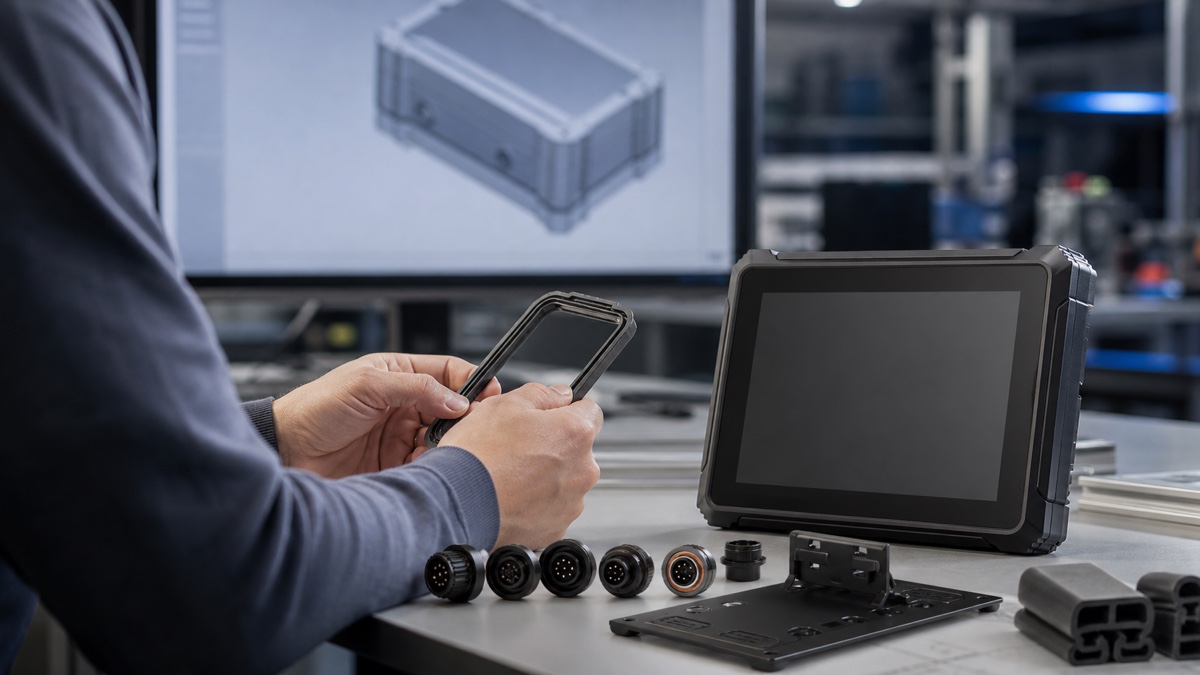
An engineering review should put the terminal, cable set, bracket and vehicle signals on the same table. A polished enclosure alone does not prove integration readiness.
Judge evidence before brochure language
Ask who owns each engineering decision
A useful first meeting includes people who understand mechanical design, electronics, firmware and production. Ask who reviews connector pinouts, who approves thermal changes and who investigates a failed field unit. When every technical question is forwarded without an owner, response time during a pilot will usually be slow. An ODM rugged vehicle computer project also needs a named path for software images, drawing revisions and approved component substitutions.
Separate a claim from its test conditions
“IP66,” “wide voltage” and “vibration resistant” are incomplete statements unless the supplier identifies the exact sample, connector state, method and revision. IEC 60529 defines enclosure protection concepts, but a rating on a housing does not automatically cover an open port or a customer-made harness. Request the relevant report or test summary, then check that it applies to the configuration on your quotation. Treat quality-system certificates in the same way: confirm the legal entity, site, scope and validity rather than relying on a logo in a slide deck.
Look for controlled changes, not a frozen promise
Long programs eventually face component, operating-system or supplier changes. The important question is how those changes are identified, tested and communicated. Ask for the normal notice route, the information included in a change notice and the buyer approval point. A disciplined OEM rugged vehicle computer manufacturer should be able to connect a shipped unit to a hardware revision, software build and inspection record.
OEM manufacturer evaluation scorecard
| Area | Evidence to request | Why it matters |
|---|---|---|
| Application fit | Written requirements and gap list | Prevents a standard unit from being sold as a custom fit |
| Engineering control | Owners, review gates and revision process | Keeps mechanical, electrical and software decisions aligned |
| Validation | Methods, sample identity, limits and result summary | Shows whether evidence matches the quoted build |
| Supply continuity | Lifecycle review and change-notice policy | Reduces surprise substitutions after approval |
| Production quality | Incoming, in-process and final inspection records | Makes acceptance repeatable beyond the first samples |
| Field support | Failure report format and escalation route | Shortens root-cause work when a vehicle is down |
What to examine during a factory review
A factory review does not need to be ceremonial. Follow one representative unit from incoming parts to packing. Look at how material identity is recorded, where work instructions are displayed, how operators handle an abnormal result and which measurements are saved. Pick a connector or display assembly from the quoted design and ask how an inspector knows that it is the approved revision. The answer should be visible in records, labels or system controls rather than dependent on memory.
At final test, compare the station with your actual acceptance needs. A power-on screen cannot prove CAN communication, cellular registration, GNSS reception, audio or camera inputs. Decide which functions need 100 percent production testing and which can be sampled. Ask how failed units are segregated, repaired and retested. If remote review is necessary, request a live walk-through focused on the agreed build and supporting records, not a general marketing tour.
Also check packing and configuration control. Labels should allow your receiving team to identify the product, revision and accessories without opening every carton. If different modem, memory or cable options share a housing, the distinction must remain clear through ordering, production and shipment. These details often reveal more about an OEM rugged vehicle computer operation than a showroom sample does.
Run the evaluation with one controlled RFQ
Send every shortlisted supplier the same requirement pack. Include a vehicle drawing or installation photos, electrical measurements at the intended power point, interface definitions, cable lengths, screen-viewing conditions, expected data flow and destination markets. Label unknowns instead of guessing. A rugged vehicle computer supplier in China may offer several processors, displays or modems under a similar enclosure, so the quoted bill of materials and option set must be explicit.
Require a compliance response with three answers for each item: compliant, compliant with modification, or not offered. The response should cite a drawing, datasheet or planned verification step. This format exposes assumptions early. It also makes quotations easier to normalize because engineering work, tooling, samples, accessories and recurring unit cost are visible rather than blended into one number.
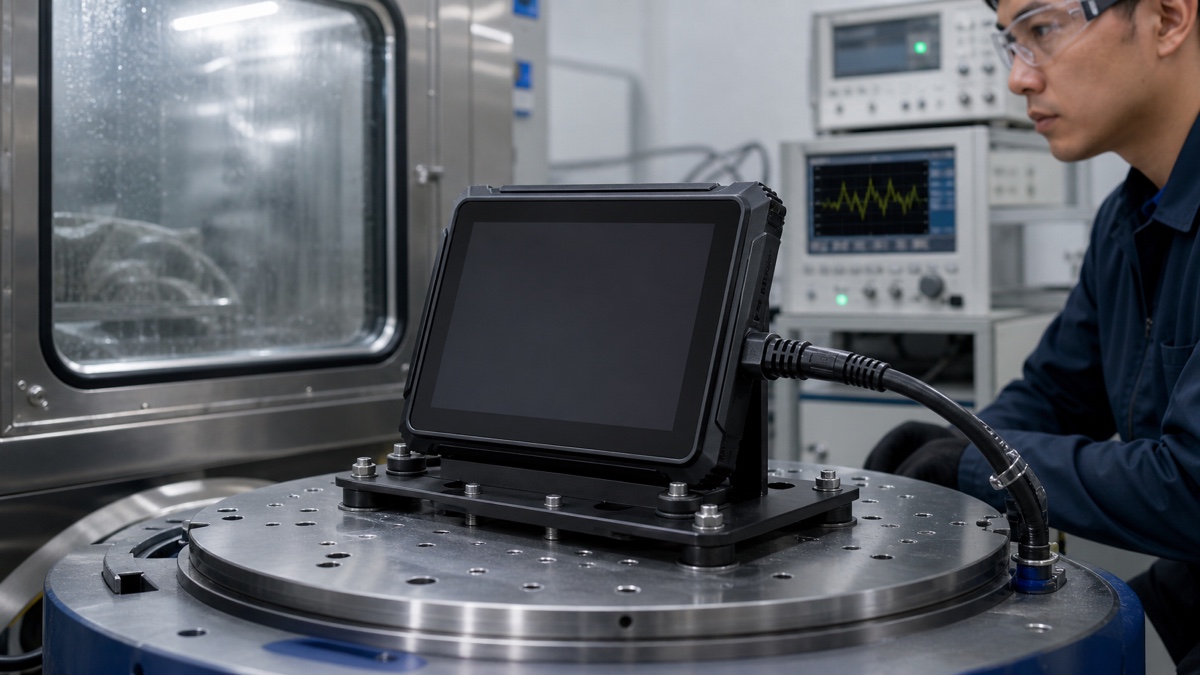
Laboratory evidence is valuable when the setup, sample revision and pass criteria are documented. The next step is still a pilot on the real vehicle.
Use samples to test the working system
A desktop inspection can confirm finish, connectors and basic software, but it cannot reproduce alternator noise, cab glare, operator gloves, antenna placement or a vibrating cable. Build a pilot checklist around normal work: cold start, repeated ignition cycles, peak accessory load, outdoor visibility, touch operation, data recovery after a link loss and safe shutdown. Photograph the mount and cable route so the production installation can be compared with the approved sample.
When something fails, keep the evidence specific. Record the unit serial number, hardware revision, software build, vehicle, time, supply trace and steps needed to reproduce the issue. A good manufacturer will separate device faults from harness, network, antenna and application causes, then return a corrective-action record that can be verified on the next build.
Compare total project cost, not only unit price
Normalize each commercial offer against the technical baseline. Separate engineering charges, tooling, test fixtures, certifications, samples, brackets, antennas, cables, packaging and recurring unit cost. Record which party owns drawings and tooling, what happens to unused material after a design change and how warranty analysis is handled. Ask the supplier to identify assumptions that could change the price.
Then model the costs that do not appear on the quotation: installation labor, application porting, field replacement, stocking variants and engineer time spent diagnosing poorly documented faults. A slightly higher device price may be reasonable if the proposed build reduces harness work or comes with better traceability. Conversely, a low sample price has little value if the final design remains undefined.
How to assess PDS for an OEM program
PDS Technology offers OEM/ODM development and a range of rugged vehicle computers and RTK GNSS terminals. Buyers can begin with screen size, operating system, vehicle interfaces, wireless communication and mounting needs, then ask PDS to identify a standard base platform and the required changes. Models such as the T7, T8, T10 and T12 provide comparison points; current interfaces, environmental options and software support should be confirmed for the exact project revision.
For an apples-to-apples decision, send PDS the same RFQ, evidence list and pilot plan used for other candidates. Ask which items are standard, which require non-recurring work and which remain subject to validation. This gives procurement a defensible basis for selecting an OEM rugged vehicle computer partner without treating a website claim as final acceptance.
Red flags that justify a pause
Pause the project if model identity changes between the sample and quotation, test reports cannot be connected to the offered configuration, or connector and cable drawings remain unavailable. Other warning signs include undocumented software images, a refusal to define pass criteria, certificates with an unrelated scope and a quotation that omits engineering assumptions. None automatically proves a bad supplier, but each must be resolved before tooling or volume orders.
FAQs
What should I send an OEM rugged vehicle computer manufacturer first?
Send the vehicle type, mounting space, measured power conditions, environmental exposure, display needs, interfaces, radio markets, software requirements and target validation plan. Mark unknown values for joint review.
Is a quality certificate enough to approve a supplier?
No. A certificate is one input. Confirm its entity, site and scope, then review product evidence, engineering controls, pilot performance and production records for your configuration.
How many pilot units are needed?
There is no universal number. Choose a sample that covers the main vehicle variants, environments and operator workflows, and agree on the acceptance logic before testing begins.
Contact us
📧Email: [email protected]
📞Tel: +86 13421822024
🌐Website: www.szpds.com
Disclaimer
The information in this article is for reference only. PDS Technology Co., Ltd. assumes no responsibility for errors, omissions, or suitability of the content for specific applications. Product specifications are subject to change without notice. Buyers should verify all technical details with our team before use.
About PDS Technology
PDS Technology is a leading OEM/ODM manufacturer of high-precision RTK GNSS terminals and vehicle computers, serving agriculture, construction, mining, taxi, and logistics industries since 2011.
With 15+ years of automotive-grade R&D experience, we offer rugged, multi-OS (Android/Linux/OpenHarmony) devices featuring RTK centimeter-level positioning, IP66 protection, and AI-ready performance. Our IATF16949-certified factories have produced over 100,000 units deployed globally, holding 30%+ of China's agricultural auto-steering terminal market. We export to Japan, the US, UK, Turkey, Russia, and beyond.