RS232 and RS485 can look like small line items on a vehicle-computer quotation. In the workshop, they affect the harness, the diagnostic method and the way the application talks to every attached device. Start with the actual machine: one nearby scanner is a different problem from six sensors spread through a trailer.
For a short, dedicated connection, RS232 is usually straightforward. For a shared run with several addressed devices, RS485 gives the integrator a more practical starting point. An RS232 RS485 vehicle terminal can support both jobs, but the port label is only the beginning. Pinout, voltage, isolation, protocol, cable route and driver behavior still need to be checked against the selected vehicle.
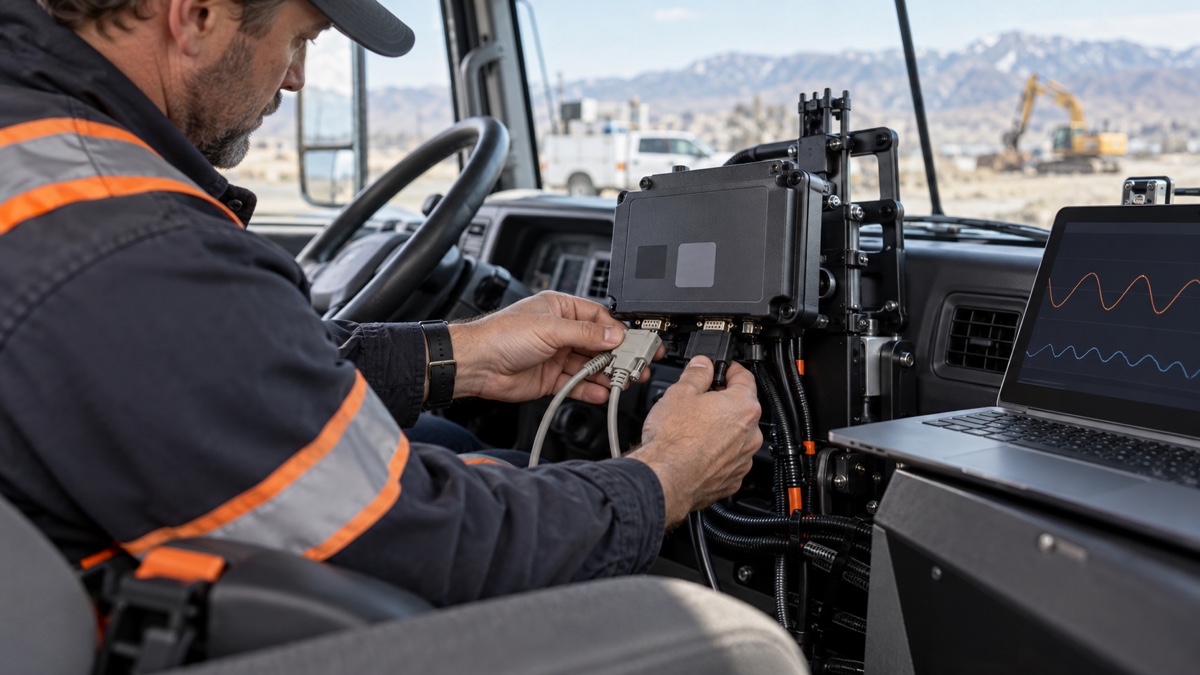
PDS application illustration. Check the connector drawing and the signal reference before the harness is released for production.
The short answer for vehicle projects
Choose RS232 when one device sits close to the terminal and already exposes an RS232 port. A barcode reader, service panel or weighing indicator often falls into this group. Choose RS485 when several nodes share one cable, when the route is long, or when the machine creates enough electrical noise to make a single-ended link uncomfortable. Choose CAN Bus when the equipment is built around structured vehicle messages and controller-to-controller traffic.
There is no prize for selecting the interface with the longest headline distance. A short harness with poor grounding can be less reliable than a longer, properly terminated bus. The useful question is: what will the terminal need to say, to whom, and under which electrical conditions?
What changes between RS232 and RS485?
Signal reference
RS232 uses a single-ended signal referenced to ground. The receiver interprets the voltage on one conductor against that reference. RS485 uses a differential pair. Its receiver compares the two conductors, which gives the link useful common-mode noise tolerance when the cable and transceiver remain within their limits. Differential signaling helps; it does not make a bad installation immune to faults.
One device or a shared bus
The normal RS232 mental model is one transmitter and one receiver. RS485 can place multiple nodes on a bus, commonly with one driver active at a time in a half-duplex design. That saves cable in a sensor network, but it adds addresses, turnaround timing and a recovery plan for a silent node. The software team should agree on those rules before anyone labels the wires.
Distance is a system property
RS232 is normally kept to a short route at common industrial baud rates. RS485 can cover a longer run, but the result depends on cable impedance, data rate, termination, stubs and grounding. The frequently quoted 1200 m figure is a lab-style limit under suitable conditions. A 30 m agricultural implement harness can still fail if it is routed beside a motor cable or if the return path is left to chance.
Grounding, isolation and transients
A vehicle brings relay transients, motor noise, load changes and sometimes a meaningful difference between equipment grounds. RS232 is more exposed to ground shift. RS485 still needs a valid common-mode range, and isolated transceivers can be worthwhile where supplies are separate. Add surge protection and a defined shield strategy to the design review; do not leave them to the installer.
Termination and topology
RS232 does not need bus termination. RS485 generally needs termination at the two physical ends of the bus, with biasing selected so the idle state is stable. Long stubs and star wiring create reflections. Before copying a working harness from one truck to another, draw the node order, measure the cable, and record where the termination resistors actually are.
A practical comparison
| Interface | Where it helps | What to prove |
|---|---|---|
| RS232 | One nearby scanner, display, service port or legacy controller | Cable length, signal reference, flow control and connector retention |
| RS485 | Several sensors or controllers sharing a controlled cable | Protocol addressing, bus ends, bias, isolation and fault recovery |
| CAN Bus | Structured messages between vehicle controllers | Message ownership, bit rate, termination and safety behavior |
Suppose a printer is mounted beside the cab computer. An RS232 cable is probably less work than adding a converter. Now suppose five implement sensors run down a trailer. A shared RS485 bus may reduce the harness, but only if the nodes, addresses and termination are documented. The right answer follows the installation, not the marketing label.
Where each serial interface fits
RS232 for a direct service or accessory link
RS232 is convenient during commissioning. A technician can connect a USB adapter, open a terminal program and see the stream without first building a bus manager. That simplicity is useful for a maintenance port, scanner or single display. It does not remove the need for strain relief, sealed connectors, protected routing and a defined ignition-start sequence on the finished vehicle.
RS485 for several field devices
RS485 is a natural candidate for remote I/O, trailer modules, implement sensors and a group of controllers that can take turns on one pair. Decide whether the network is half-duplex or full-duplex, which device starts a transaction, how long a reply may take, and what the terminal does after a timeout. Those decisions matter more than the number of pins on the connector.
When CAN Bus should be considered
CAN Bus is often the better fit for high-volume machine data and several controllers publishing defined messages. RS232 and RS485 remain useful for legacy equipment and sensors without CAN. A rugged vehicle terminal with CAN Bus, RS232 and RS485 can bridge systems, but the application should decide which interface owns a value instead of forwarding every frame everywhere.
Selecting an RS232 RS485 vehicle terminal
| Question | A likely RS232 answer | A likely RS485 answer |
|---|---|---|
| How many devices? | One dedicated connection | Several addressed nodes |
| What is the route? | Short route with a known ground | Longer daisy-chain with controlled stubs |
| What does software expect? | A simple serial stream | Polling, addresses and timeout rules |
| What is the electrical risk? | Ground shift on a short, quiet link | Common-mode voltage, surge and termination |
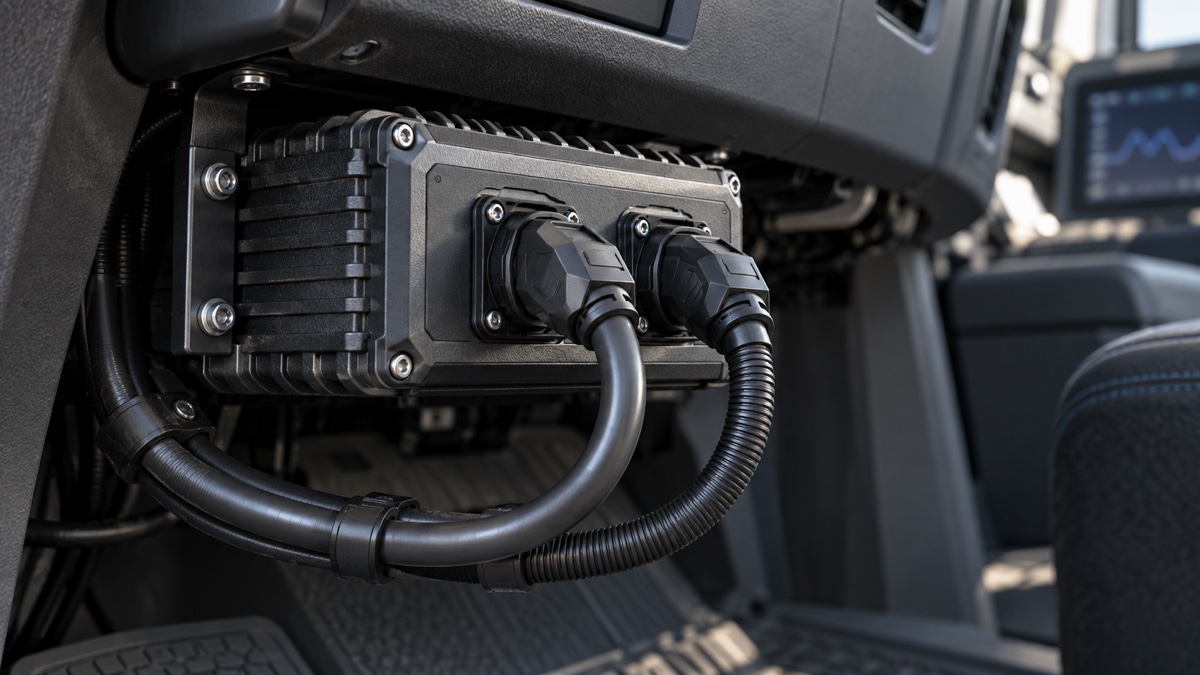
Serial-interface detail illustration. Keying, strain relief, isolation and cable routing should be checked on the exact terminal revision.
PDS terminal options to check
PDS builds rugged vehicle computers and RTK GNSS terminals for agriculture, construction, mining, public transport and fleet work. Model and connector options vary. Published configurations include RS232, RS485 and CAN Bus on the T8 8-inch vehicle computer, expandable serial and CAN combinations on the T10 10-inch vehicle computer, and dual CAN with serial and camera options on the T12 12-inch vehicle computer.
Ask for the exact pinout, voltage level, isolation, baud-rate range, flow-control behavior and protocol direction in the quotation. Android projects should confirm how the serial device is exposed to the application. Linux projects should confirm the device node and RS485 direction control. A port count without those details is not an integration plan.
Validation before the vehicle leaves the workshop
Begin with a loopback or simulator, then connect one real device and save the raw trace. Repeat with the engine running, a motor under load and the main relays switching. Measure both ends of the harness. Check the voltage between equipment grounds. Unplug and reconnect a node, cycle the ignition, and record how the application recovers.
For RS485, test every node and then test one node missing. Record cable length, stub length, termination and bias values. For RS232, verify that flow control is not hiding a slow application and that connector strain cannot interrupt the link. Keep the firmware version and interface settings with the vehicle build record so a field replacement is repeatable.
FAQs
Can one RS232 RS485 vehicle terminal support both interfaces?
Yes, when the exact hardware configuration exposes both ports and the operating system supplies the required drivers. Confirm the pinout and software mapping for the product revision rather than relying on the family name.
Is RS485 always more reliable?
No. RS485 helps on shared and noisy links, but poor termination, ground offset or an untidy harness can still fail. A short, protected RS232 connection can be the more dependable choice.
Should every RS485 device have 120 ohm termination?
Normally termination belongs at the two physical bus ends, not at every node. The correct arrangement depends on cable, rate, topology and the transceiver. Measure the completed network instead of applying a blanket rule.
When should a project choose CAN Bus?
CAN Bus is usually preferable when several vehicle controllers exchange structured messages at defined rates. Serial links remain useful for legacy devices, sensors and service channels. A mixed design should assign one owner to each data source.
Request a serial integration review
Send PDS the device list, cable lengths, baud rates, protocols, connector photographs and vehicle-voltage conditions. The engineering team can review the terminal configuration before a sample is ordered. Visit the PDS vehicle computer range or contact PDS Technology for product options.
Contact us
Email: [email protected]
Tel: +86 13421822024
Website: www.szpds.com
Disclaimer
The information in this article is for reference only. PDS Technology Co., Ltd. assumes no responsibility for errors, omissions, or suitability of the content for specific applications. Product specifications are subject to change without notice. Buyers should verify all technical details with our team before use.
About PDS Technology
PDS Technology is a leading OEM/ODM manufacturer of high-precision RTK GNSS terminals and vehicle computers, serving agriculture, construction, mining, taxi, and logistics industries since 2011.
With 15+ years of automotive-grade R&D experience, we offer rugged, multi-OS (Android/Linux/OpenHarmony) devices featuring RTK centimeter-level positioning, IP66 protection, and AI-ready performance. Our IATF16949-certified factories have produced over 100,000 units deployed globally, holding 30%+ of China's agricultural auto-steering terminal market. We export to Japan, the US, UK, Turkey, Russia, and beyond.