Two things send a cab terminal back to the supplier. The first is a battery that swells inside a year. The second is a machine that has to be parked because the display cannot face the weather.
Both get filed under "the device failed". They are not the same failure. One is a chemical process with a predictable timeline. The other is usually a protection level that was never specified for the position the terminal actually occupies. A rugged vehicle computer chosen around the working day treats them as two separate engineering questions, because they have two separate answers — the same framing behind the working-day approach in this guide to vehicle computers for precision agriculture.
Get the distinction right and both failures become forecastable. The first one becomes removable from the design entirely.
A cab is a greenhouse, and a lithium cell inside it is a wear part
A closed machinery cab behaves like a greenhouse. Published work on tractor cabins measured an uncooled interior dry-bulb temperature of around 34 °C, falling to roughly 29 °C once active cooling intervenes. That is the idle state on a bright day. Lithium-ion degradation is generally described as accelerating above about 35 °C, a threshold a parked cab passes routinely through a European summer.
Heat alone would be manageable. What makes a permanently installed cell different is that heat never arrives alone.
Sustained high state of charge. A terminal bolted into a cab is connected to the machine's supply every day the machine works. Left plugged in, its cell sits near full charge for months. Lithium-ion chemistry is designed to cycle rather than to be held at the top of its range — a point the University of Reading's guidance on swollen lithium-ion batteries makes directly, warning against leaving a device continuously on charge once the charge cycle is complete.
Vibration. A machine working a field loads its electronics continuously. A review in Wiley's Engineering Reports, An Overview of the Impact of Vibrations on Li-Ion Battery, reports that prolonged vibration exposure produces electrode delamination, separator deformation and electrolyte leakage, which appear electrically as rising internal resistance and falling capacity. The failure is mechanical before it is electrical.
Put those three together and the outcome stops being a quality question. Swelling is gas produced by electrolyte decomposition inside a sealed pouch — the visible symptom of a cell whose internal structure has already failed, not a cosmetic defect. Consumer lithium packs under hot-vehicle exposure are commonly described as reaching the end of practical life somewhere between twelve and eighteen months. That matches the pattern reported from the field at around a year, which is what you would expect if the mechanism, and not the supplier, is what sets the clock.
Key Takeaway: Inside a permanently installed terminal, the cell is not a feature. It is a wear component with a finite life, mounted in the hottest and most vibration-exposed position on the machine.
The practical consequence is inventory. A cell that fails at fourteen months on a machine with a ten-year programme is not a warranty event, it is a recurring one. The failure also arrives with hardware attached: a swollen pouch pushes against whatever encloses it, and the repair is a unit that has to be unbolted, removed from the machine and returned. On the afternoon it happens, the machine stops.
The second failure is electrical, and it has nothing to do with the battery
Here is where a specification review most often goes wrong. Strip the battery out and a rugged vehicle computer is still connected to a vehicle supply, and a vehicle supply is not a laboratory supply. Engine cranking, alternator behaviour, relay switching and inductive loads all produce conducted transients on the very lines feeding the terminal.
ISO 7637-2 defines those transients for road vehicles. It is worth knowing what each pulse represents, because "we tested to ISO 7637" tells you nothing until you know what was tested.
|
Pulse |
What it represents |
Character |
|---|---|---|
|
1 |
Supply disconnection from an inductive load, for equipment sitting directly in parallel with it |
Negative transient, relatively high source impedance, tens to hundreds of volts |
|
2a |
Sudden current interruption in a circuit parallel to the device, driven by harness inductance |
Positive transient; roughly +37 to +50 V in a 12 V system, source resistance around 2 Ω, microseconds to tens of microseconds |
|
2b |
A DC motor acting as a generator after ignition-off |
Higher energy and longer duration than 2a |
|
3a / 3b |
Switching and arc events such as relay or contactor operation |
Fast, low-energy negative (3a) and positive (3b) spikes, source resistance around 50 Ω |
|
4 |
Starter cranking |
A supply voltage dip rather than a spike; tests for reset, data loss or malfunction |
Load dump deserves separate attention, because its home has moved. Semiconductor application literature on automotive supply protection records that when the load-dump requirement moved out of ISO 7637-2 into ISO 16750-2, the minimum test requirements increased at the same time — multiple pulses at one-minute intervals rather than a single event. ISO 16750-2:2023 now carries load dump in a sub-clause of its own, with an informative annex explaining where the pulse originates in a vehicle electrical system. A supplier citing a 2004-vintage ISO 7637-2 reference and one citing a current ISO 16750-2 report are not describing the same test.
The same standard defines the supply-voltage window the equipment must tolerate. The 2023 edition sets a maximum supply voltage of 16 V for 12 V nominal systems and 32 V for 24 V nominal systems, with the minimum set by a code agreed between customer and supplier — anywhere from 6 V to 10.5 V on a 12 V system. Separately, it specifies a long-term overvoltage test for alternator regulator failure at 18 V for 60 minutes on a 12 V system and 36 V for 60 minutes on a 24 V system, applied to all relevant inputs. Read those against agricultural machinery, where 24 V systems are routine and supply quality varies with the machine's electrical architecture.
Pro Tip: Ask for the pulse list, not the standard number. A supplier who can name which pulse types were applied, at what severity level, and with the harness and connector included in the tested configuration has done the engineering. A supplier who can only name the standard has read it.
This is the point that undoes the intuitive conclusion. A terminal with no internal battery has removed the swelling mechanism completely — and remains just as exposed to pulse 2a or a load-dump event as any other device on the machine. The two fixes are independent. Specifying one does not buy you the other.
A vehicle-powered terminal removes one failure mode outright
The design response to the first problem is not a better cell. It is not needing one.
A rugged vehicle computer that takes its power from the machine and stores nothing has no electrolyte to decompose, no state of charge to manage, no pouch to swell and no cell to replace at fourteen months. It also removes a line item from the spares plan and a class of return from the service process — the parts of total cost a unit-price comparison never shows. The PDS terminals are built this way: vehicle-powered with no internal battery, permanently installed on the machine rather than removed and carried between shifts, with a published 9–36 V DC input range referencing the ISO 7637-II vehicle power standard and an operating range of −20 °C to +70 °C.
Three consequences follow, and all three belong in a procurement conversation rather than a technical one.
First, the shutdown question moves. With no cell to hold the system up, the terminal depends on a defined ignition sequence and a controlled shutdown window to save data before the supply drops. That is a software and wiring decision, and it should be documented rather than assumed.
Second, standby current becomes a real number. A permanently connected device draws from the machine battery around the clock, and a machine parked for three weeks is a machine whose battery that terminal has been sitting on.
Third, the absence of a battery says nothing about ingress protection, transient tolerance or temperature range. Each of those is a separate specification, verified separately. A battery-free design is one failure mode removed, not a general guarantee.
IP66, IP67 and IP69K are three different tests, not three levels of waterproof
Now to the part that decides whether the machine goes out in the rain — and the part where most results for a waterproof vehicle computer will mislead you.
The second digit of an IP rating is not a ladder, and treating it as one is the most common specification error in this category. IEC 60529 defines a specific test behind each number, and the tests measure different things.
|
Rating |
Test |
Defined parameters |
|---|---|---|
|
IPX6 |
Powerful water jets from any direction |
12.5 mm nozzle bore, around 100 L/min, approximately 100 kPa at 3 m, minimum 3 minutes |
|
IPX7 |
Temporary immersion |
1 m depth for 30 minutes |
|
IPX9K |
High-pressure, high-temperature washdown |
Water at 80 °C ± 5 °C, 8–10 MPa, 14–16 L/min, nozzle 100–150 mm from the specimen, 30 s at each of four angles |
The first numeral is the same in each: 6 means dust-tight.
So an IP66 enclosure is dust-tight and survives a powerful jet. It is not tested for immersion — that is IP67 — and it is not tested against a hot pressure washer at 80 °C and 100 bar, which is IP69K, a designation whose "K" comes from ISO 20653 for road vehicle components. Several published guides in this category describe IP66 as protection against temporary flooding. That is wrong, and it is the kind of error that turns into a field failure when a machine is cleaned or when a terminal ends up sitting in standing water.
What the rating does not cover, at any number: sunlight readability, operating temperature, vibration, or the condition of the cables and connectors attached to it. An IP66 enclosure with an unsealed connector is a rated housing inside an unrated assembly, and the tested configuration is the only thing the certificate describes.
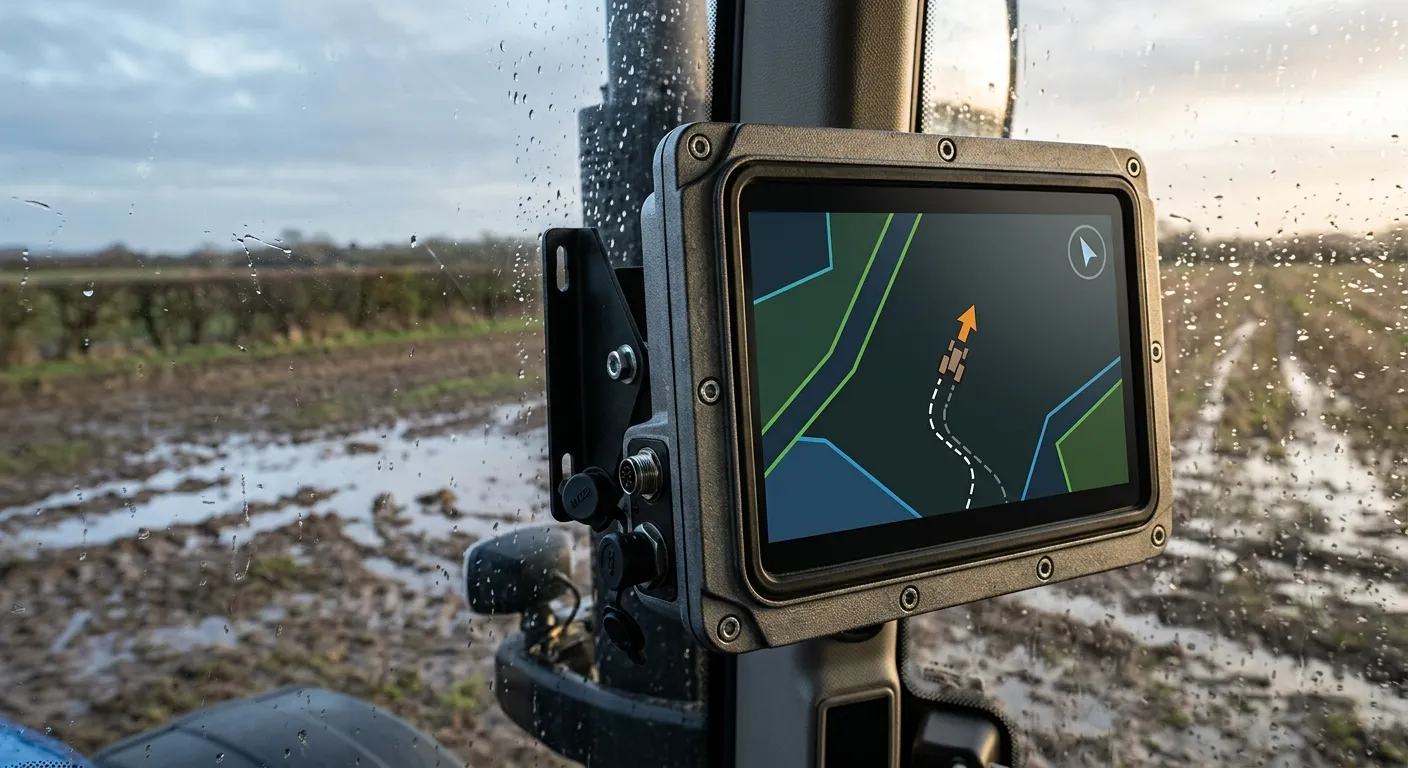
For a terminal mounted inside a sealed cab and used through a wet season, the practical question is not which number is highest. It is whether the rating was obtained on the configuration you are installing, including the harness, the connector caps and the mounting penetrations. The PDS terminals publish IP66. If your installation puts the unit somewhere that is pressure-washed directly, that is a different requirement and should be specified as one — a DLG test report on a cab-mounted surround-view display illustrates how far the expectation shifts with position, from a basic rating inside a dry cab upward as exposure increases.
What the rain rule actually costs you in a season
The reason this matters is not the terminal. It is the calendar.
If the display has to come off the machine whenever rain is forecast, three things happen at once. Setup time reappears every working day, because a re-installed unit needs its bracket, its connectors and its position re-established. The machine has to be under cover, which for a parked implement in a wet spell is often not available. And the operator loses the guidance interface for exactly the part of the season that needs it most — the weeks when a wet field is the norm rather than the exception.
That last point is where the operational cost concentrates. A terminal that keeps working through rain and on waterlogged ground does not just save a daily unbolt. It keeps the auto-steering workflow available on the days when pass-to-pass repeatability matters most and a second pass over a wet field does measurable harm. The terminal is a component in that chain, and an agricultural auto-steering solution only delivers guidance if the interface is present and readable on the days the work is actually being done.
⚠️ Warning: If a supplier quotes a weatherproofing claim without naming the tested configuration, treat the claim as unverified. The enclosure may be rated and the installation may not be.
If you searched for "vehicle mount tablet"
A note on vocabulary, because it sends buyers to the wrong product class.
Search for a vehicle mount tablet and most results are exactly that: holders and brackets for a consumer tablet — dashboard mounts, seat-rail brackets, cup-holder arms, headrest holders. Those products solve a mounting problem. They do not address power architecture, transient tolerance, ingress protection, thermal range or ignition behaviour, because the tablet they hold was never designed for a machine.
An integrator specifying an in-cab terminal is not buying a holder. The distinction between rugged and industrial vehicle computers is a more useful one, because it separates design priorities rather than mounting hardware — and it is the distinction that determines whether the unit survives a machine programme or a single season.
The failure-mode table, and what to request for each row
This is the document to take into a supplier review. Each row pairs a symptom with its root cause, the standard that governs it, and the evidence that settles the question.
|
Symptom |
Root cause |
Governing standard |
Evidence to request |
|---|---|---|---|
|
Cell swollen at about 12–18 months; housing distorted |
Electrolyte decomposition under sustained heat and permanent high state of charge, plus vibration-induced cell damage |
Design choice rather than a rating — verify by architecture |
Whether an internal cell exists at all, and if so its qualified temperature range and the storage condition specified for a parked machine |
|
Device damaged or reset during machine operation |
Conducted transients on the supply line |
ISO 7637-2 pulses 1, 2a, 2b, 3a, 3b, 4; ISO 16750-2 for load dump and supply windows |
Pulse types and severity levels tested; whether the harness, fuse and connector were in the tested configuration |
|
Terminal unusable in rain or wet conditions |
Ingress protection not matched to the mounted position |
IEC 60529, and ISO 20653 for washdown positions |
The rating, plus confirmation that it was obtained on the installed configuration including connectors and penetrations |
|
Work stops when the machine is left outside |
Terminal removed and re-installed between shifts |
Operational rather than a rating |
Whether the unit is designed to remain installed and powered through weather, and its specified operating temperature range |
|
A spare part that recurs annually |
The cell is a consumption item |
Design choice |
The spares list, and whether a battery-free option exists in the range |
Verify it in one working day
Mechanism decides whether a design can work. Configuration decides whether this installation does. One day on your own machine settles more than a document review.
Run the machine through a normal shift with the terminal installed as it will be in service. Power-cycle the ignition repeatedly and confirm the shutdown sequence saves the current job. Leave the machine parked outdoors overnight in rain with the terminal installed, then start the next day's work without touching the mounting or the connectors. If washdown is part of your operation, clean it the way your operators actually clean it, then check the connector seals and cable entries rather than the screen. At the end of the day, compare the timestamp on the terminal's record with your field record; a gap in the recorded track says more about the power architecture than any datasheet.
Then ask for the two numbers that are still open: the tested pulse list for the supply input, and the qualified temperature range for whatever sits inside the sealed enclosure.
FAQ
Do rugged vehicle computers have internal batteries?
Some do and some do not, and the answer is architectural rather than cosmetic. A terminal with an internal cell carries a consumable inside a sealed enclosure mounted in the hottest position on the machine; a vehicle-powered terminal with no cell removes that failure mode and the recurring downtime that comes with it. Ask which design you are being quoted, because the two behave differently at around the twelve-month mark.
Is IP66 waterproof enough for field work in rain?
IP66 is dust-tight and survives a powerful water jet from any direction — 12.5 mm nozzle, around 100 L/min at approximately 100 kPa. Rain and wet ground fall well inside that. IP66 does not cover immersion, which is IP67, and does not cover a hot high-pressure washer at 80 °C and 8–10 MPa, which is IP69K. Whether IP66 is sufficient depends on where the terminal is mounted and how the machine is cleaned, not on the rating alone.
What actually causes a battery to swell in a machine cab?
Three things acting together: sustained heat in a closed cab, a cell held permanently near full charge because the terminal is connected every working day, and continuous machine vibration. Heat drives electrolyte decomposition and gas formation, the permanent high state of charge removes the cycling the chemistry is designed for, and vibration causes internal mechanical damage. The swelling is the visible end of a process that starts earlier.
If the terminal has no battery, is it immune to electrical damage?
No. Removing the battery eliminates one failure mode — cell swelling. It does not reduce exposure to conducted transients on the vehicle supply line, which are a separate hazard governed by a separate standard. Transient protection has to be specified and verified on its own terms, whatever the power architecture is.
Does an IP rating tell me the terminal will work in a wet field?
It tells you that the tested enclosure configuration met a defined dust and water-ingress level. It says nothing about sunlight readability, operating temperature, vibration tolerance, or the condition of the connectors and cables attached to it. Those are separate specifications and need separate evidence.
What should I ask a supplier before specifying a rugged vehicle computer?
Four things: which pulse types and severity levels were tested on the supply input and whether the harness was included; whether the unit contains an internal cell and, if so, its qualified temperature range; the IP rating together with confirmation that it was obtained on the installed configuration; and the qualified operating temperature range of the complete unit.
Where to go from here
The two failures in this article are worth separating in your own specification template, because they are settled by different documents. Keep a power architecture question — does anything inside this sealed box degrade on a calendar — next to a transient question and an ingress question, and require evidence for each.
If you want a full worked example, the published specifications for the T12 12-inch vehicle mounted computer list the 9–36 V DC input referencing ISO 7637-II, IP66 sealing, an operating range of −20 °C to +70 °C, MIL-STD-810 vibration and shock testing, and no internal battery. Take it as one configuration to measure your own requirements against.
Then run the one-day check. A day in the rain with the terminal installed will tell you more about the specification than a week of datasheets.
Contact us
📧Email:[email protected]
📞Tel:+86 13421822024
🌐Website: www.szpds.com
Disclaimer
The information in this article is for reference only. PDS Technology Co., Ltd. assumes no responsibility for errors, omissions, or suitability of the content for specific applications. Product specifications are subject to change without notice. Buyers should verify all technical details with our team before use.
About PDS Technology
PDS Technology is a leading OEM/ODM manufacturer of high-precision RTK GNSS terminals and vehicle computers, serving agriculture, construction, mining, taxi, and logistics industries since 2011.
With 15+ years of automotive-grade R&D experience, we offer rugged, multi-OS (Android/Linux/OpenHarmony) devices featuring RTK centimeter-level positioning, IP66 protection, and AI-ready performance. Our IATF16949-certified factories have produced over 100,000 units deployed globally, holding 30%+ of China's agricultural auto-steering terminal market.We export to Japan, the US, UK, Turkey, Russia, and beyond.