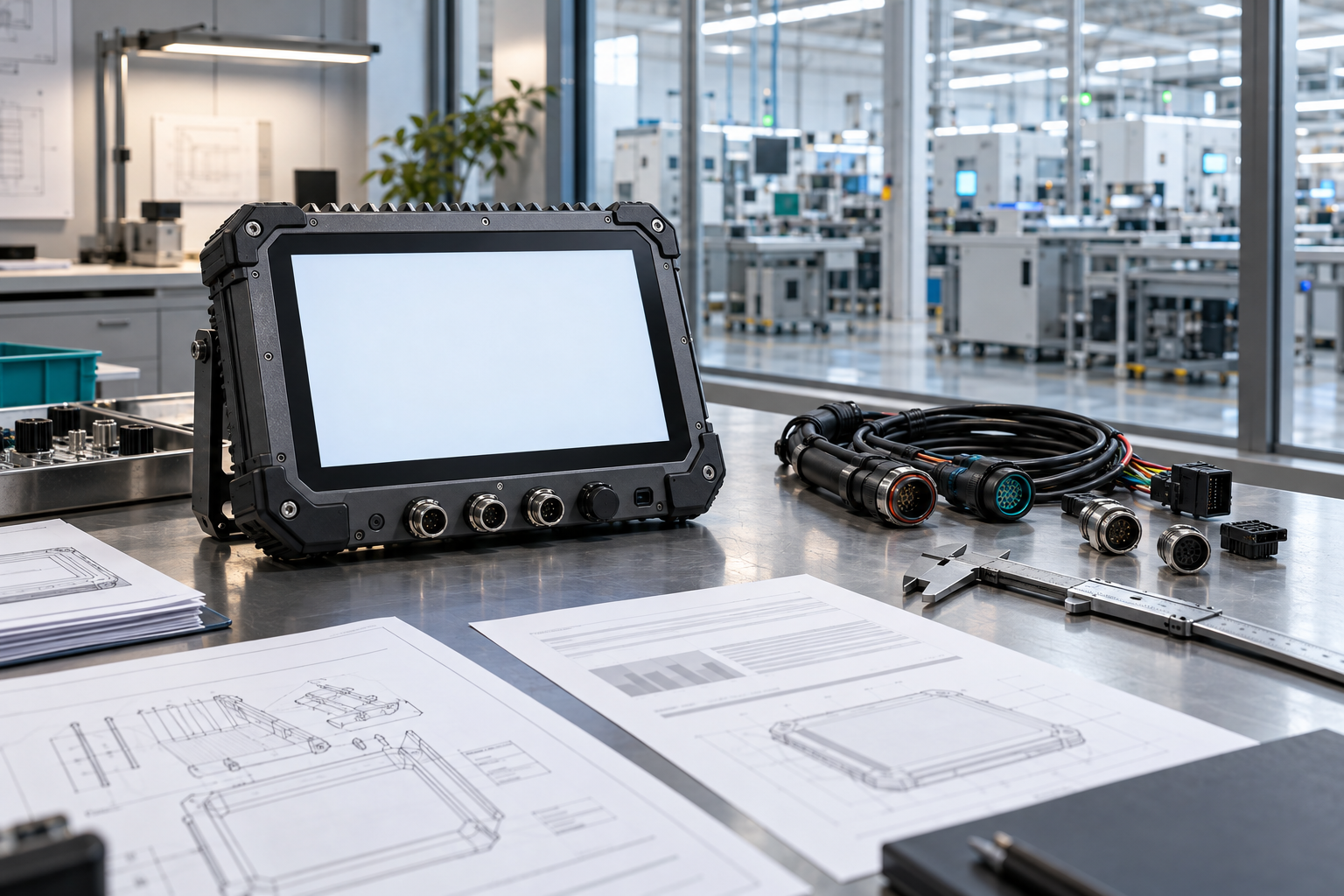
A 4G LTE vehicle mounted computer becomes valuable when a fleet stops treating connectivity as an accessory and starts treating it as part of the operating system. Dispatch jobs, electronic proof of delivery, vehicle diagnostics, navigation updates, driver communication and workshop data all compete for the same moving network connection. The terminal must keep working when coverage drops, when the ignition cycles, and when several applications need data at once.
The right design is not simply a rugged display with a cellular module inside. It combines a stable vehicle power interface, carefully placed antennas, local storage, sensible software behavior and a deployment process that can manage dozens or thousands of vehicles. This guide explains what connected fleet teams should verify before choosing a 4G LTE vehicle mounted computer.
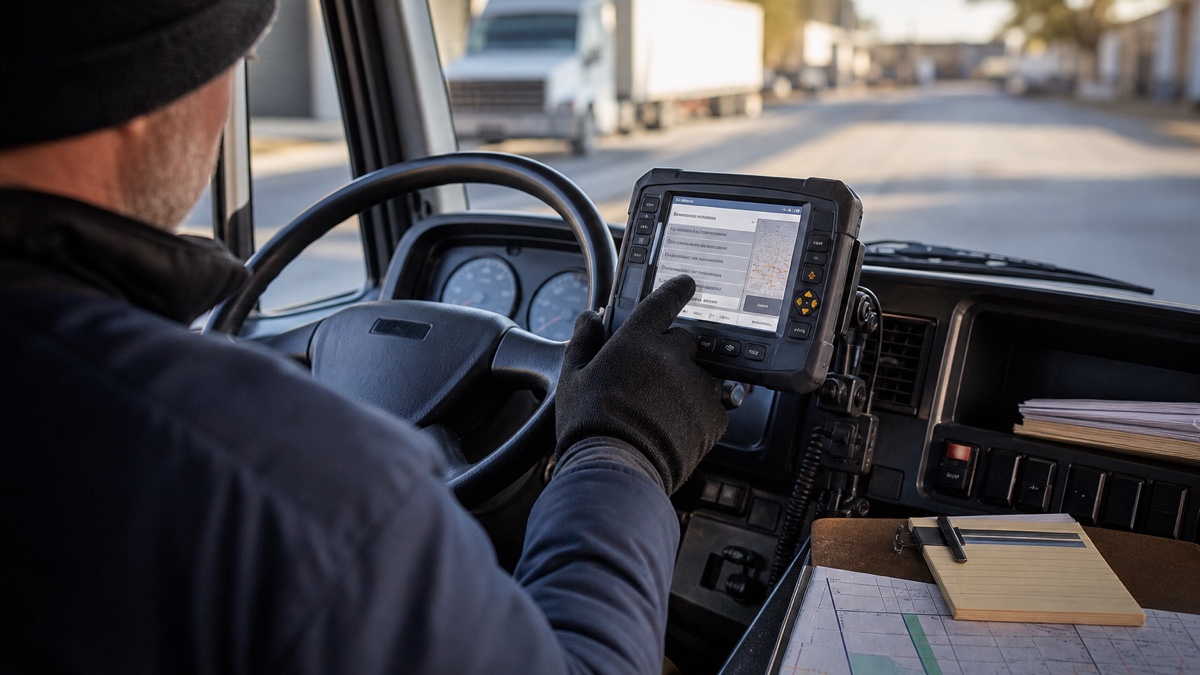
Connected fleet illustration. Cellular performance depends on antenna placement, vehicle metalwork, network conditions and the complete installation.
Industry challenges behind connected fleet programs
Fleet operations rarely happen in ideal radio conditions. A vehicle may begin the shift in a dense urban yard, cross a rural service road, stop inside a cold-storage building and return through a congested depot. Each location changes signal strength, available bands and network load.
At the same time, users expect the terminal to behave like a familiar tablet. Drivers want quick route changes and clear instructions. Dispatchers want timely job status. Maintenance teams want fault codes and vehicle health without waiting for the truck to return. Management wants utilisation, fuel and safety data without creating a second system that nobody trusts.
A weak implementation creates familiar problems: duplicated records, missed messages, stale routes, inconsistent timestamps and support calls that cannot be reproduced. Those issues usually come from the system architecture, not one missing cellular bar on the screen.
What a 4G LTE vehicle mounted computer must handle
Reliable connectivity without assuming permanent coverage
The device should support the cellular bands and carrier approvals required in each market. It should also manage reconnection after tunnels, dead zones, network switching and vehicle sleep. The application needs a local queue so an event is not lost merely because the uplink is unavailable.
Define which data is urgent and which can wait. A safety alert or failed delivery event may need immediate transmission. A routine position update can be batched. This distinction reduces data cost and prevents low-value traffic from delaying important messages.
Vehicle-grade power and thermal behaviour
Vehicle electrical systems are not clean laboratory supplies. Cranking, load dump, accessory switching and extreme temperatures can interrupt consumer hardware. Ask how the terminal behaves during ignition-off, sleep, wake and low-voltage conditions. Confirm the supported input range, protection concept, fuse recommendation and shutdown policy for the target vehicle.
Thermal design matters as well. A closed cab in summer, direct sunlight and continuous navigation can raise internal temperatures. The mounting location should allow airflow and avoid blocking vents, speakers or service access.
Useful interfaces for the whole vehicle
A connected terminal may need CAN Bus for vehicle data, RS232 or RS485 for existing equipment, USB for service tools, digital inputs for status signals and camera inputs for safety views. The correct combination depends on the vehicle and application. Avoid selecting a port count before the data map is clear.
Software access is equally important. Android projects usually need a documented API or managed device framework. Linux projects need stable drivers and a predictable device tree. OpenHarmony projects need a defined compatibility layer. A connector that works on a bench is not enough if the application team cannot access it reliably after an update.
Connectivity features to specify
| Requirement | What to verify | Why it matters |
|---|---|---|
| Cellular coverage | Supported bands, carrier certification, roaming and antenna options | Determines whether the terminal can operate across the fleet's real routes |
| Network recovery | Reconnect timing, local buffering, sleep behaviour and failover policy | Protects records and commands during tunnels, dead zones and maintenance windows |
| Positioning | GNSS accuracy, update rate, antenna placement and correction service | Supports dispatch, routing, proof of service and vehicle utilisation reporting |
| Security | Device identity, encrypted transport, access control and update signing | Protects fleet data and limits the impact of a lost or serviced unit |
| Manageability | Remote configuration, logs, health status and software deployment | Keeps a growing fleet consistent without relying on manual visits |
The device should not be judged by peak download speed alone. A stable link at a lower rate is often more valuable than a fast connection that disappears whenever the vehicle moves. Test latency, packet loss, reconnection time and behaviour across cell boundaries as part of acceptance.
Recommended architecture for a connected fleet
Treat the terminal as an edge node rather than a thin screen. It can validate sensor data, timestamp events, filter duplicate messages, store a short offline queue and present information immediately to the driver. The cloud platform should receive a controlled data model rather than raw device messages that change with every hardware revision.
A practical deployment also needs a configuration baseline. Record firmware, application, network profile, antenna type, interface mapping and vehicle-specific settings. When a unit is replaced, the workshop should be able to restore that baseline without guessing.
If the fleet operates across borders, confirm roaming agreements and data residency rules early. If vehicles serve depots in several countries, a single SIM profile may not be commercially or technically appropriate. The same review should cover private APN access, firewall rules and support escalation paths.
Application example: mixed urban and regional delivery
Consider a delivery company running vans in a city and light trucks on regional routes. The city vehicles benefit from frequent job updates, route guidance, electronic signatures and depot messaging. Regional vehicles may spend longer periods between towns and need stronger offline behaviour.
Both groups can use the same terminal platform, but their configuration should differ. Urban units may upload location and delivery events more frequently. Regional units can batch routine telemetry and reserve bandwidth for proof of delivery, mechanical alerts and driver communication. This reduces data consumption without weakening operational visibility.
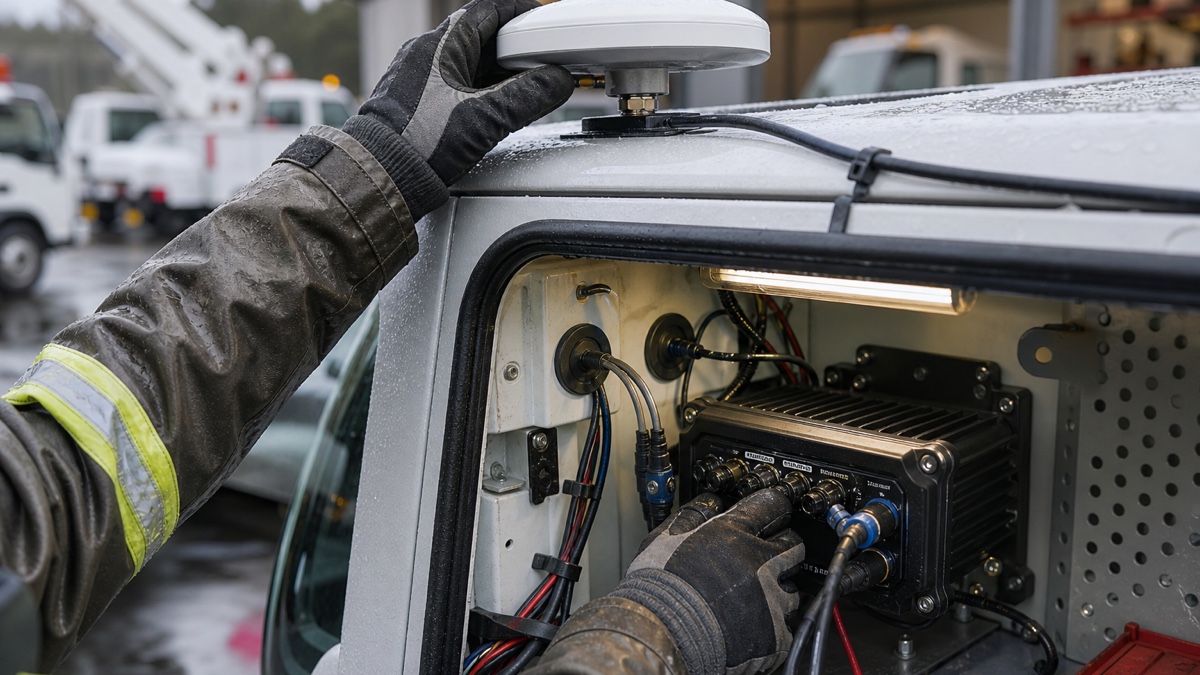
Fleet test illustration. Confirm connectivity, power, positioning and application behaviour together before installing the full fleet.
How PDS vehicle computers support 4G LTE projects
PDS Technology manufactures rugged vehicle computers and RTK GNSS terminals for agriculture, construction, mining, public transport, taxi and logistics applications. Its multi-OS product range supports Android, Linux and OpenHarmony deployments, with model-dependent options for 4G LTE, GNSS, CAN Bus, serial interfaces, camera inputs and IP66-rated protection.
The PDS T8 8-inch vehicle computer suits fleets that need a compact dashboard terminal. The T10 10-inch vehicle computer offers more screen space for dispatch and workflow applications. The T12 12-inch vehicle-mounted computer is intended for installations that need a larger interface and broader expansion. Exact cellular bands, certifications and interface combinations vary by configuration and should be confirmed for each market.
For fleet platform or OEM integration, PDS can review the OEM/ODM requirements around device identity, application distribution, interfaces and mechanical mounting. Fleet operators can also review the fleet management solution overview before defining the deployment architecture.
Buying checklist for fleet and OEM teams
Prepare a route map, vehicle power profile, data plan, application inventory and service process before the supplier discussion. Ask for a sample configuration that matches the production harness, not a generic evaluation board. Then test the terminal with the real antenna location, real SIM profile and real vehicle body.
Check whether the supplier can provide the technical documentation your software team needs. A data sheet is useful; an API guide, device tree, recovery procedure, firmware policy and interface test report are often more valuable. Confirm spare-part availability and the process for replacing a unit in the field.
| Buyer question | Evidence to request |
|---|---|
| Will the terminal work on our routes? | Band plan, carrier approval, antenna recommendation and field test plan |
| Can it survive our vehicles? | Power specification, temperature range, protection rating and mounting guidance |
| Can our software be deployed consistently? | OS image, SDK, update method, configuration backup and recovery procedure |
| Can we support the fleet after rollout? | Diagnostics, replacement units, warranty process and lifecycle commitment |
FAQs
Is 4G LTE fast enough for fleet dispatch and vehicle data?
In most dispatch, messaging, navigation and telemetry applications, yes. The more important questions are coverage, latency, reconnection behaviour and the volume of data sent by each application. Video streaming or frequent full-resolution uploads require a separate bandwidth assessment.
Does a 4G LTE vehicle mounted computer need GNSS?
Not every application requires GNSS, but fleet dispatch, proof of service, route reporting and vehicle utilisation usually become more useful when position and time are available locally. If GNSS is required, confirm antenna placement and accuracy rather than assuming the cellular module includes suitable positioning.
Can the terminal continue working without a network connection?
It should. The application needs an offline mode, local data retention and a clear reconnection policy. Drivers should still be able to view their job, record status and complete safety tasks while the terminal waits to synchronise.
Should every vehicle use the same SIM and data plan?
Not necessarily. Urban and regional vehicles can have different data profiles. Cross-border fleets may need roaming or local SIM strategies. The decision should follow route coverage, cost, support and regulatory requirements.
Plan a connected fleet pilot with PDS
Share the vehicle types, operating regions, expected monthly data volume, interface list, application stack and mounting constraints with PDS Technology. The engineering team can help shortlist a rugged terminal configuration and identify the connectivity questions that must be tested before a larger rollout. Start with the PDS product range or contact PDS Technology.
Contact us
📧Email:[email protected]
📞Tel:+86 13421822024
🌐Website: www.szpds.com
Disclaimer
The information in this article is for reference only. PDS Technology Co., Ltd. assumes no responsibility for errors, omissions, or suitability of the content for specific applications. Product specifications are subject to change without notice. Buyers should verify all technical details with our team before use.
About PDS Technology
PDS Technology is a leading OEM/ODM manufacturer of high-precision RTK GNSS terminals and vehicle computers, serving agriculture, construction, mining, taxi, and logistics industries since 2011.
With 15+ years of automotive-grade R&D experience, we offer rugged, multi-OS (Android/Linux/OpenHarmony) devices featuring RTK centimeter-level positioning, IP66 protection, and AI-ready performance. Our IATF16949-certified factories have produced over 100,000 units deployed globally, holding 30%+ of China's agricultural auto-steering terminal market. We export to Japan, the US, UK, Turkey, Russia, and beyond.