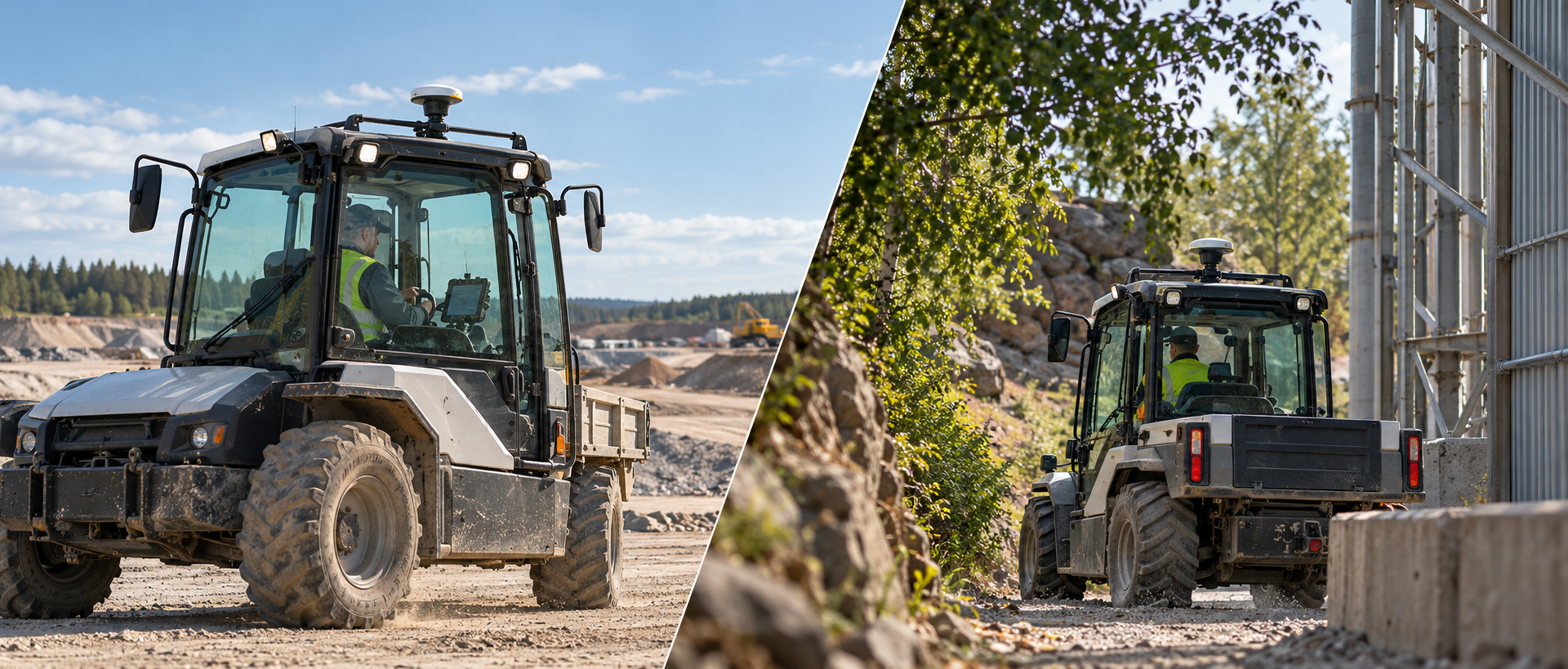
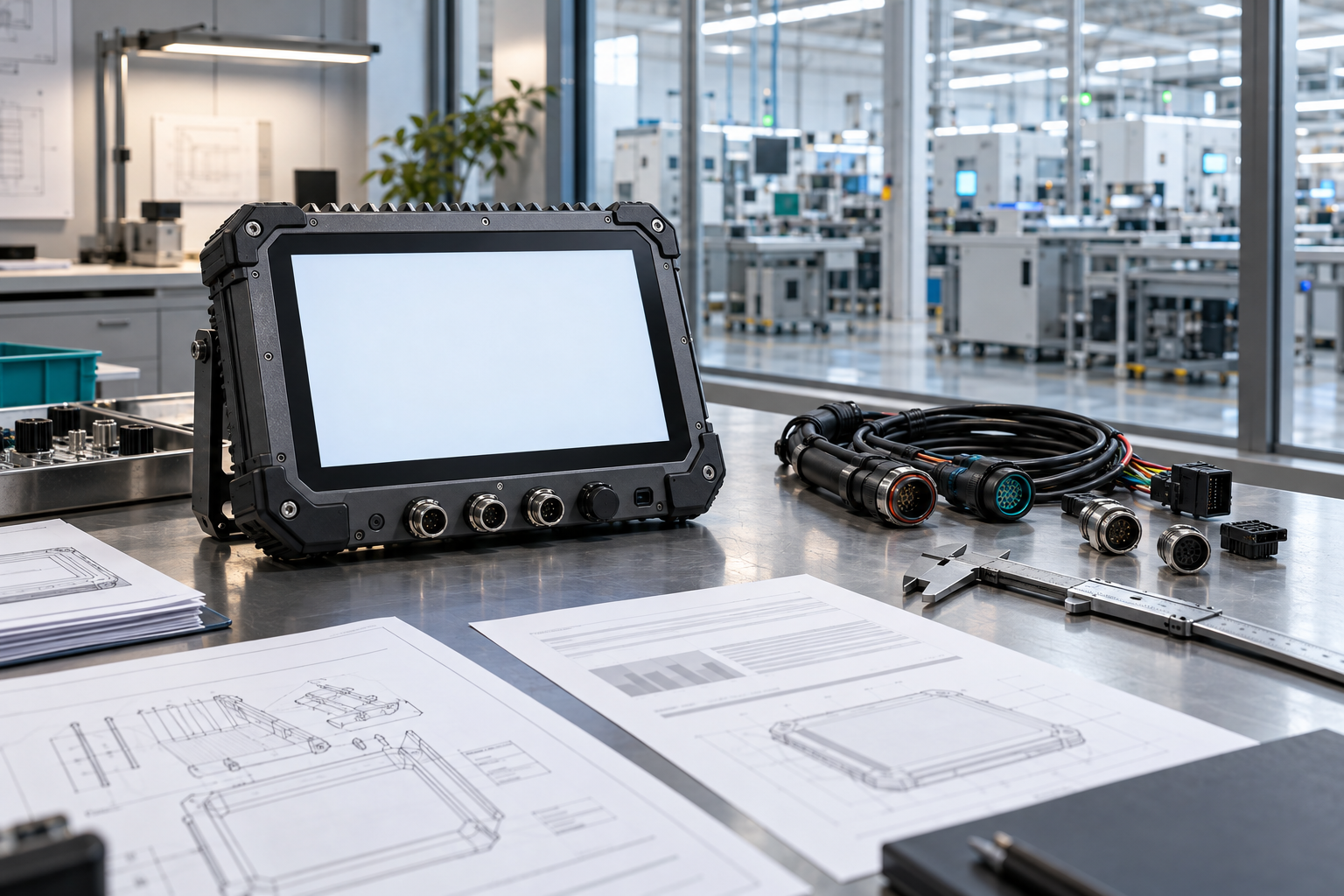
A GNSS vehicle terminal with CAN Bus combines two different views of a machine. GNSS explains where the vehicle is, how it is moving and whether it is following the intended line. CAN Bus explains what the vehicle and its controllers are doing: speed, engine state, hydraulic commands, implement status and fault messages. When those data streams are designed together, a tractor, loader, truck or service vehicle can provide guidance and machine context in one interface.
The integration challenge is not merely finding a terminal with a GNSS antenna connector and a CAN port. The project must define accuracy, correction delivery, message ownership, update rates, offline behavior and installation limits. This guide covers the decisions that matter for agriculture, construction, mining and other vehicle-network applications.
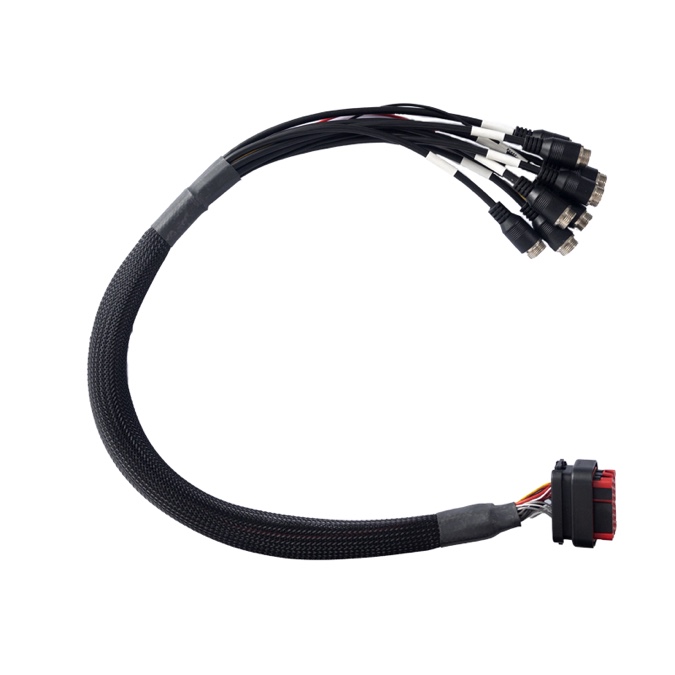
GNSS vehicle terminal with CAN Bus installation illustration. Correction quality, antenna placement, CAN mapping and wiring must be validated on the target machine.
Why GNSS and CAN Bus belong together
Position alone can tell an operator that a machine has drifted from a guidance line, but it cannot explain why. CAN data can show steering demand, implement state, engine load or a controller fault. Combining both sources allows the terminal to present a more useful event history and lets the application apply machine-specific logic.
In precision agriculture, GNSS may support centimeter-level guidance while CAN carries wheel angle, speed and implement feedback. In construction, a machine terminal can use GNSS for elevation or position and CAN for boom, bucket or travel state. In mining and logistics, the same combination can support dispatch, geofencing and vehicle-health reporting.
The two systems should not be forced into one update rate. GNSS may update at a defined navigation rate while CAN traffic arrives at different intervals or only after an event. The application should preserve timestamps and source information so the data remains explainable.
Industry challenges to solve before installation
Position stability in a real machine environment
GNSS signals can be affected by cab geometry, roof material, implement structure and nearby radio equipment. Correction data may arrive through a radio, cellular network or local base station. The terminal needs a clear behavior when corrections stop: maintain a valid but lower-accuracy solution, alert the operator, or pause guidance functions according to the safety policy.
Test the antenna in the production location, not only on a test vehicle. Confirm ground plane, cable loss, connector protection and the distance from high-power transmitters. A poor antenna installation can make good GNSS hardware look unreliable.
CAN messages with different meanings
Commercial vehicles and machinery may use J1939, CANopen, ISO-TP, UDS or a private protocol. The same identifier can describe different signals on different machine families. The project needs a message database, units, scaling, timeout rules and an owner for every transmitted message.
Do not assume that listening is always harmless. Passive monitoring still requires correct termination and bus access. Transmitting commands is a higher-risk function and needs rate limits, interlocks and a rollback plan.
Interfaces that must coexist
Many machines need more than GNSS and CAN. A terminal may also connect to RS232 or RS485 sensors, a camera, a USB service device, a cellular modem and a display. Sharing processor time and interrupt load should be part of validation. A bench test with one interface is not enough evidence for a production machine.
Device requirements for a GNSS vehicle terminal with CAN Bus
| Category | Design question | Project evidence |
|---|---|---|
| GNSS | Accuracy, constellation support, update rate and correction source | Antenna drawing, sky-view test, correction log and accuracy trace |
| CAN Bus | Channel count, bit rate, protocol, termination and transmit policy | Harness schematic, DBC or message list and bus-load capture |
| Software | Driver, API, permissions, process recovery and data logging | SDK sample, fault-injection result and versioned application package |
| Power and protection | Input range, ignition policy, surge protection, isolation and mounting | Vehicle electrical test, fuse plan and installation checklist |
| Lifecycle | Updates, configuration backup, diagnostics and spare-unit provisioning | Approved release process and field recovery procedure |
Recommended features for machine guidance
RTK positioning and clear fallback states
For applications that require centimeter-level positioning, RTK GNSS can be the right foundation. The terminal should expose the correction state, satellite quality and solution age in a way the application can use. Do not hide accuracy loss behind a generic green icon.
The machine's safety plan should define what changes when GNSS quality falls. Some operations may continue with reduced speed, while others should stop guidance and ask the operator to take manual control. This is an application decision, not a hardware default.
Controlled CAN access and diagnostics
A production terminal should let the OEM restrict which identifiers can be transmitted and which services can be started. Log bus health, error frames, timeouts and configuration changes. When a machine returns to the workshop, the technician needs evidence, not only an error screen.
Rugged enclosure and practical mounting
Cab vibration, dust, moisture and temperature cycling are normal conditions in agriculture, construction and mining. Choose a mounting position that protects the connectors, leaves room for service and keeps the screen visible without interfering with controls. Confirm IP66-rated protection where the installation requires washdown or exposed operation.
Application example: tractor guidance with implement feedback
A tractor guidance system may use RTK GNSS to position the machine and CAN Bus to read wheel angle, ground speed and implement state. The terminal displays a guidance line, records coverage and monitors whether the implement is in the expected state. If corrections stop, the interface can warn the operator and preserve the last valid coverage record.
The same architecture can be adapted to a construction machine by changing the message map and safety rules. The hardware may be similar, but the software behavior and validation plan must reflect the machine's actual functions.
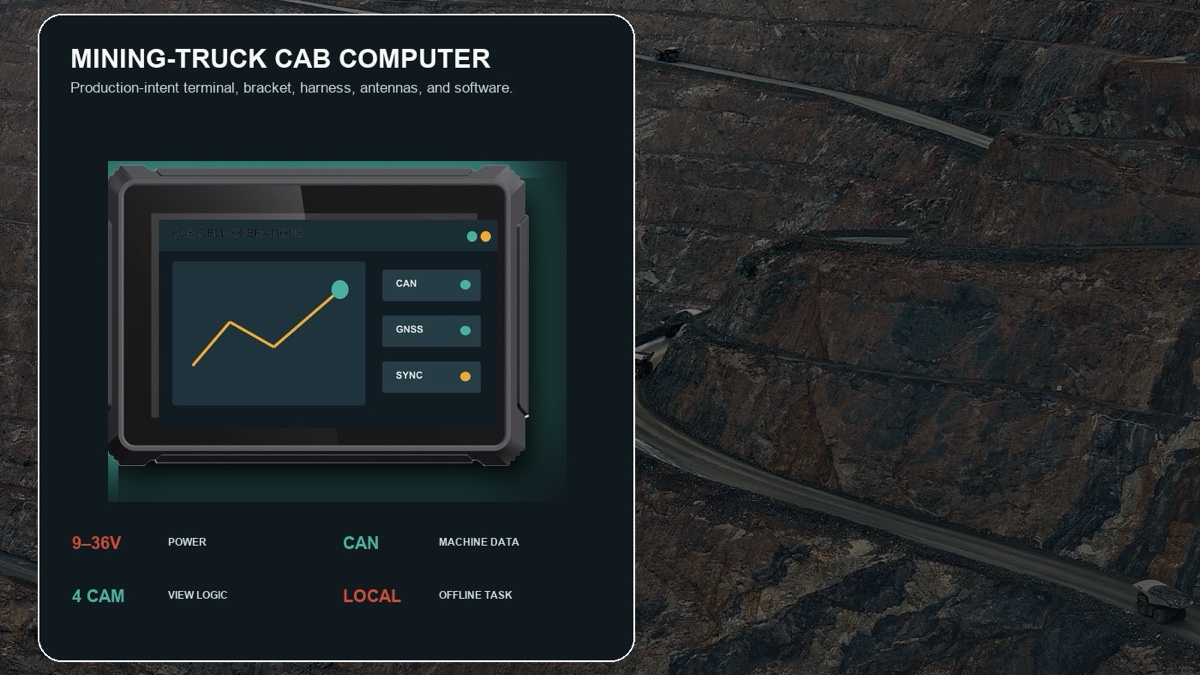
Precision agriculture illustration. Antenna calibration, correction quality and CAN feedback should be checked as one guidance workflow.
How PDS supports GNSS and CAN Bus integration
PDS Technology builds RTK GNSS terminals and rugged vehicle computers for agriculture, construction, mining, taxi and logistics. Its rugged range uses automotive-grade design practices and supports Android, Linux and OpenHarmony deployments, with model-dependent options for RTK positioning, CAN Bus, RS232, RS485, 4G LTE, camera input and IP66 protection.
The T8 8-inch vehicle computer is a compact option for tractor and machine cab layouts. The T10 10-inch vehicle computer provides a balance of screen area and installation flexibility, while the T12 12-inch vehicle-mounted computer supports larger guidance and machine-monitoring interfaces. Exact GNSS performance, interface combinations and environmental ratings depend on the selected model and configuration.
For project planning, review the precision agriculture solutions and construction and mining solutions. OEM teams can use the PDS OEM/ODM process to align connectors, software support and mechanical requirements.
Acceptance tests before production release
Record a baseline route with a reference GNSS receiver and a CAN analyzer. Repeat the test with the production terminal, harness, antenna and software build. Compare position accuracy, correction age, CAN decode values and event timing. Add engine load, hydraulic activity, radio transmission and other likely noise sources.
Then perform fault tests. Disconnect the antenna, interrupt corrections, remove a CAN node, send invalid data, cycle ignition and restore power. The application should enter a defined state each time. Record which warnings appear, which data is retained and how the operator recovers.
FAQs
Can one terminal support RTK GNSS and CAN Bus at the same time?
Yes, if the selected model exposes both interfaces and the software stack handles them concurrently. Confirm the GNSS configuration, CAN channels, update rates and shared processor load with the exact product revision.
Does RTK always deliver centimeter-level accuracy?
No. RTK can provide centimeter-level positioning when corrections, satellite geometry, antenna installation and environmental conditions are suitable. Accuracy can degrade when corrections stop or the antenna is obstructed. The application must handle that change explicitly.
Is J1939 required for every CAN Bus project?
No. J1939 is a higher-layer protocol commonly used in heavy-duty vehicles. Agricultural, construction and specialty machines may use CANopen, ISO-TP, UDS or a private protocol. Select the terminal and software toolchain around the machine's actual message definition.
Where should GNSS processing happen?
Use the terminal where immediate positioning, guidance, alerts and offline operation are required. A cloud service can support fleet reporting, remote analysis and long-term data storage, but it should not be the only place where safety-relevant status is evaluated.
Discuss your GNSS and CAN project with PDS
Send PDS the machine type, required positioning accuracy, correction method, CAN protocol, message list, interface inventory, power conditions and mounting constraints. The engineering team can review a terminal configuration before a sample build. Visit the PDS vehicle terminal range or contact PDS Technology to start the discussion.
Contact us
📧Email:[email protected]
📞Tel:+86 13421822024
🌐Website: www.szpds.com
Disclaimer
The information in this article is for reference only. PDS Technology Co., Ltd. assumes no responsibility for errors, omissions, or suitability of the content for specific applications. Product specifications are subject to change without notice. Buyers should verify all technical details with our team before use.
About PDS Technology
PDS Technology is a leading OEM/ODM manufacturer of high-precision RTK GNSS terminals and vehicle computers, serving agriculture, construction, mining, taxi, and logistics industries since 2011.
With 15+ years of automotive-grade R&D experience, we offer rugged, multi-OS (Android/Linux/OpenHarmony) devices featuring RTK centimeter-level positioning, IP66 protection, and AI-ready performance. Our IATF16949-certified factories have produced over 100,000 units deployed globally, holding 30%+ of China's agricultural auto-steering terminal market. We export to Japan, the US, UK, Turkey, Russia, and beyond.