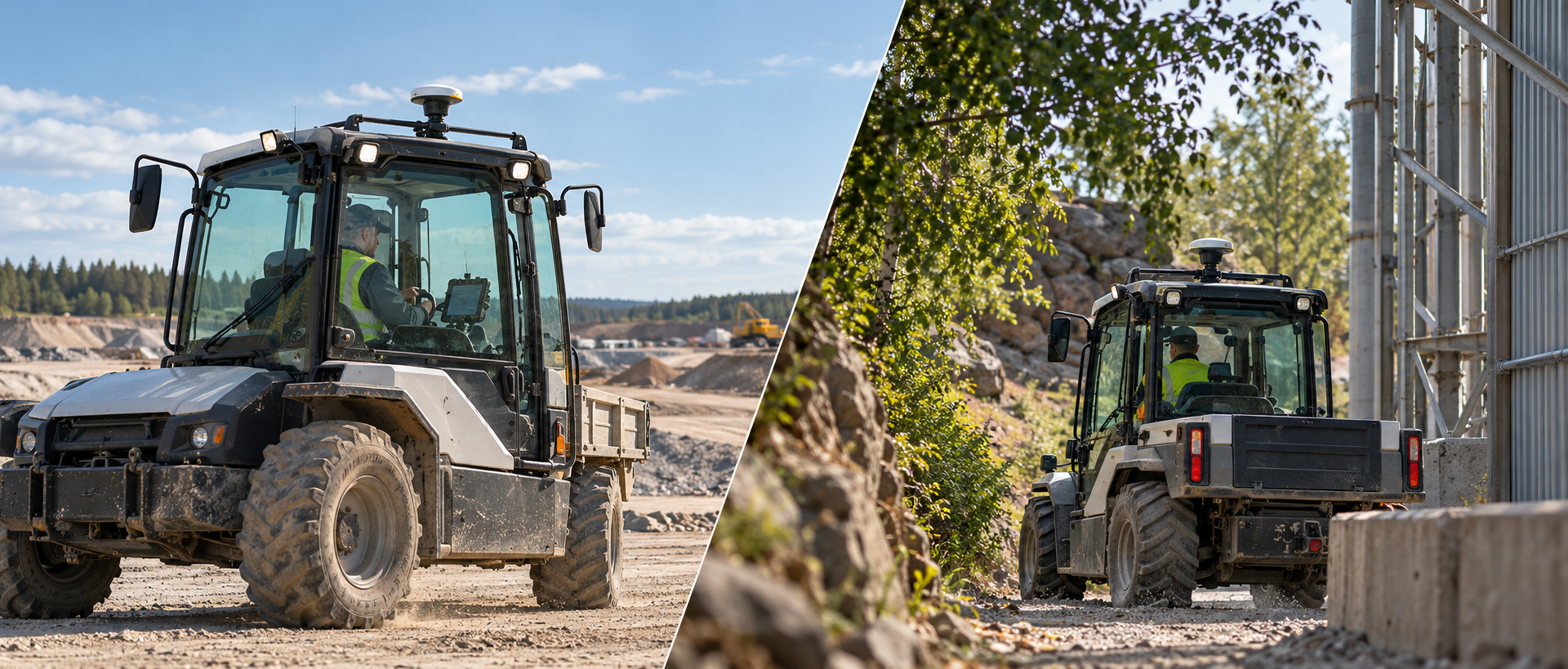
A rugged vehicle mounted computer rarely fails all at once.
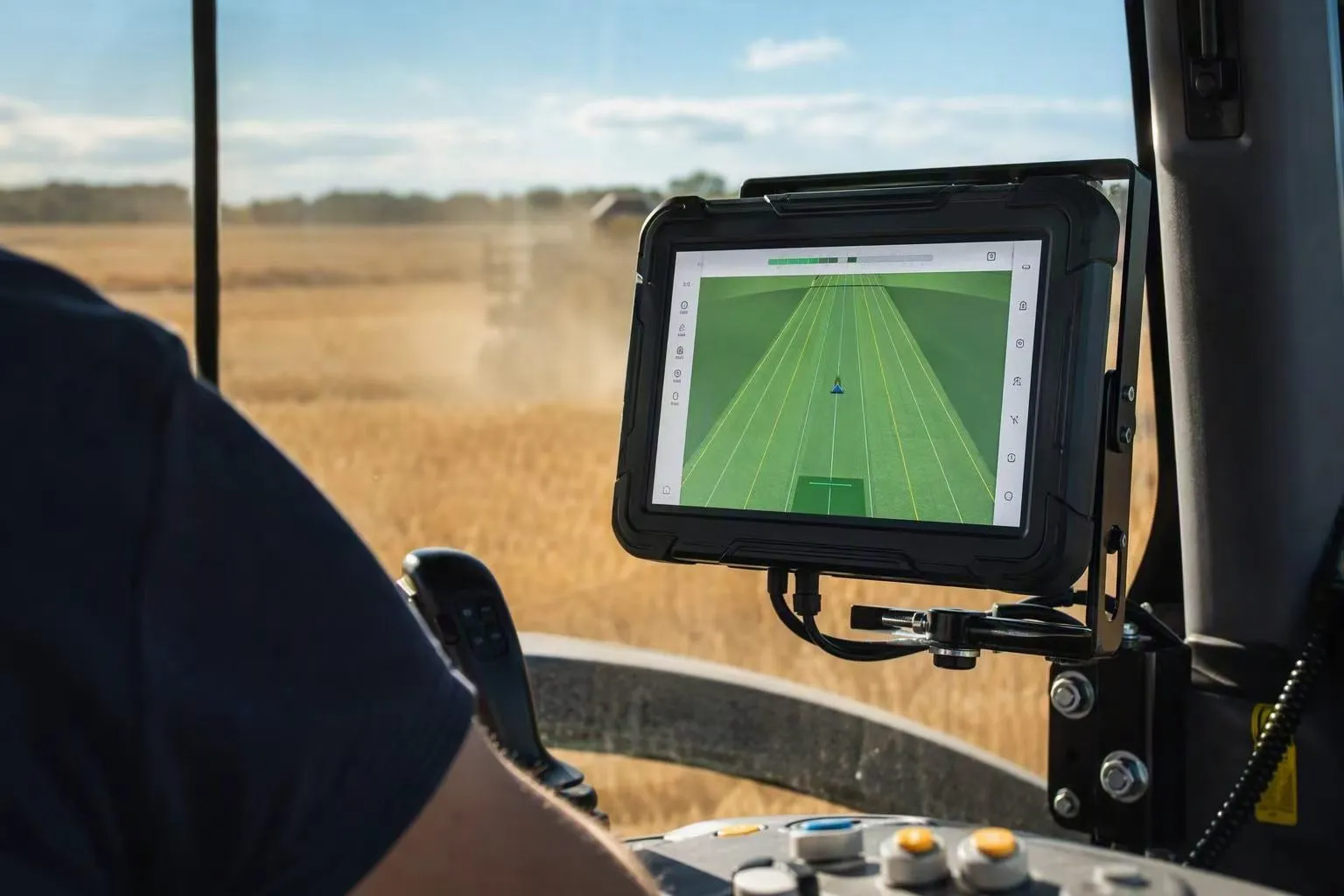
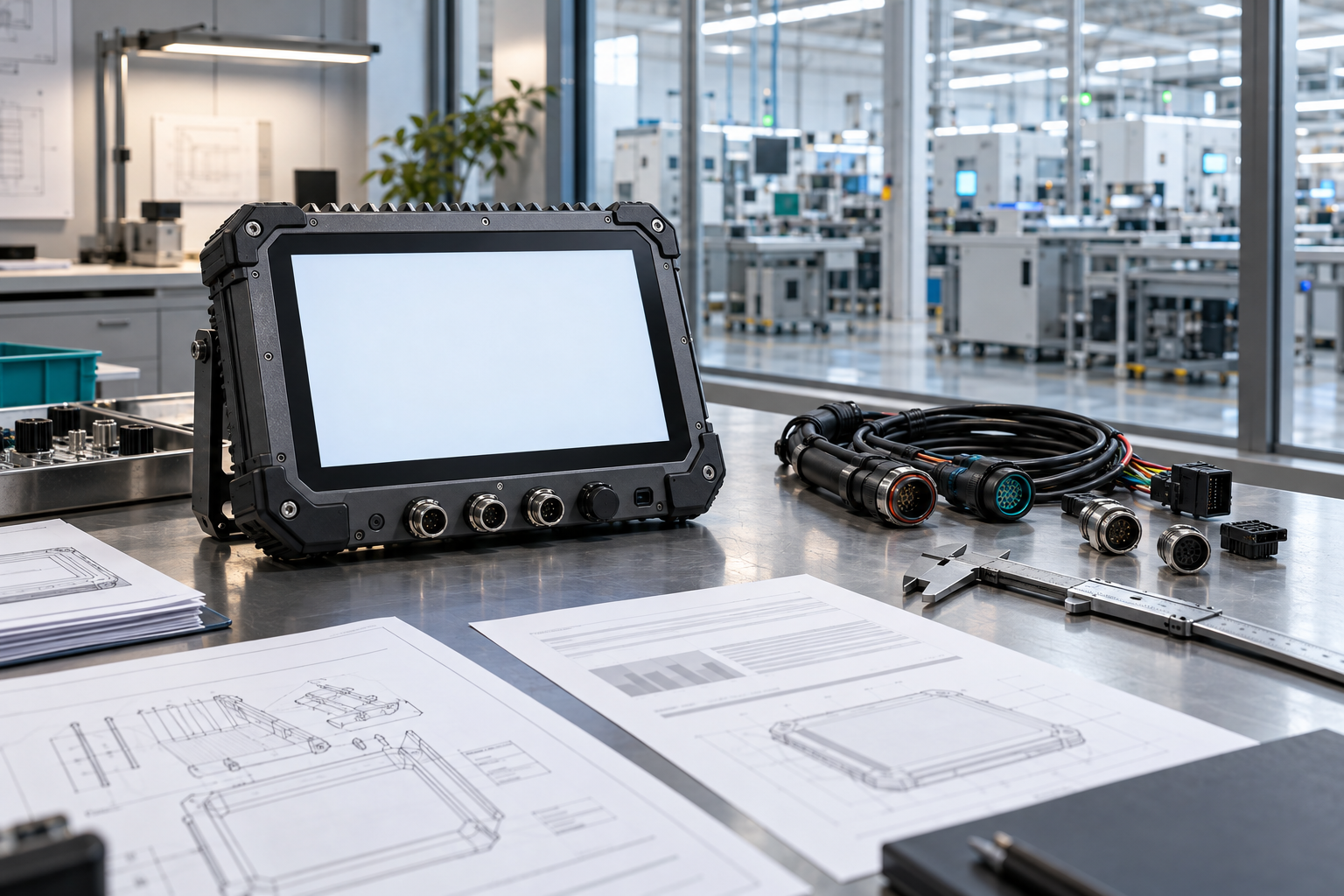
It becomes unreliable in four stages: the screen washes out at midday, the power stage drops the unit during a cold start, guidance drifts a metre or two off the intended line, and the whole assembly comes off the machine before the next rain front arrives. By the time the operator stops trusting it, the specification has already been signed.
This guide is written for the people who have to sign it — procurement leads and product engineers at precision agriculture solution providers who buy in-cab computing hardware for integration. It does not rank products. It converts four common failure modes into criteria you can test, questions you can put to any supplier, and evidence you should refuse to proceed without.
What a vehicle mounted computer actually is
A vehicle mounted computer is a fixed-installation terminal, powered from the machine's electrical system and mounted in the cab or on the implement, designed to run for the length of a working shift. That definition carries the design logic: no portability requirement, no need for a removable battery, and every incentive to optimise for continuous operation in a hostile thermal and electrical environment.
A vehicle mount tablet sits in a different category. It is a portable device with its own power source, docked in the cab and carried out when the shift ends — genuinely useful for inspection work, field scouting and fleet management, where the operator moves between machines.
In an auto-steering loop, where the terminal is the operator interface for a machine that runs ten hours a day, portability is not a feature. The internal battery that enables portability becomes a liability.
Pro Tip: Establish the device class before comparing specifications. A portable tablet with an IP67 rating and a 1,000-nit screen can win a feature comparison against a fixed terminal while failing the actual job, because portability and continuous duty pull in opposite directions.
Most suppliers publish terminals across several sizes, and screen size usually follows viewing distance rather than feature tier. The PDS rugged vehicle terminal range, for instance, spans 7-inch to 12.1-inch classes, and a screen on the cab pillar at arm's length has different legibility requirements than one recessed into a console.
Sunlight readable vehicle computer: brightness is only the entrance fee
If your operators cannot read the screen at midday, the device is not working, regardless of what else it does.
Open-field operation at solar noon in summer produces ambient illuminance above 100,000 lux, and because the machine faces a different direction with every pass, that light frequently hits the display face straight on. CAN in Automation's technical note on sunlight readability in off-highway vehicles makes the point bluntly: luminance alone does not settle the question, because thin-film bonding, anti-glare treatment and internal reflection decide how much of that light ends up as glare inside the panel.
The numbers help set expectations. Consumer-grade displays typically deliver 300–500 nits, sunlight-readable industrial displays in this category are commonly rated at 750 nits and up, and mainstream vendor guidance converges on 1,000 nits as a comfortable outdoor baseline and 1,500 nits or more for open-field agricultural use.
Treat those as ranges rather than a pass mark. A bright panel behind glossy cover glass can be harder to read than a lower-rated panel with proper bonding and a matte surface. A terminal such as the T12 12-inch vehicle mounted computer pairs a 750-nit high-brightness IPS panel with a wide 9–36V input and an IP66 enclosure — a combination worth putting through the checks below.
None of that can be settled on paper. Take the machine out at midday, point it into the sun, and check the display from the angle the operator actually sits at, with gloves on and dust on the screen face.
Then test the night setting, because a display that cannot dim far enough is unusable for night spraying — exactly when the schedule is tightest.
Two standards are worth knowing, along with their limits.
ISO 15008 sets minimum requirements for image quality and legibility of dynamic displays, but its stated scope covers passenger-car displays presented to a driver while the vehicle is in motion — it is an ergonomic reference, not a ruggedness or agricultural certification. Human-factors guidance derived from it treats minimum character height as a function of viewing distance and viewing conditions, which is a useful sanity check on any interface you plan to deploy: ask the supplier how their HMI was dimensioned against the standard, rather than accepting a bare brightness figure.
A vehicle powered computer without an internal battery
The second failure mode is less visible and more expensive: a terminal that relies on an internal battery and is left permanently mounted in a cab.
The mechanism is thermal, not electrical. A battery kept at high temperature and held near full charge ages faster than the same cell cycling in a cooler environment, and cab temperatures in summer sunshine routinely exceed the design range of consumer cells.
Progressive capacity loss follows, then swelling, then a device that shuts down mid-pass or damages the electronics around it. A vehicle powered computer removes the failure mode at the source: it draws from the machine's electrical system, has no internal battery at all, and stays installed on the machine rather than being carried off. Nothing to age in the heat, nothing to swell.
Pro Tip: Park the machine in the sun after a working day, leave the terminal powered as it would be in normal use, and look at it again the following morning. If the enclosure is warm to the touch or the unit has dropped off the bus, the thermal design is being carried by battery chemistry rather than by architecture — a problem that will surface in the customer's fleet within a season.
Accepting vehicle power means accepting the machine's electrical environment, and that environment is not clean.
The ISO 7637 series defines the disturbances an in-cab device sees on 12V and 24V systems, and the interesting ones are real events rather than laboratory curiosities. Pulse 1 is the negative spike when an inductive load connected in parallel — a relay, a solenoid, a motor — is switched off while your device stays connected. Pulse 2a is a positive spike from a sudden current interruption in the harness, and pulses 3a and 3b are fast bursts of very short spikes from switching elsewhere in the wiring. Pulse 4 is not a surge at all but a sag: bus voltage collapsing while the starter motor turns.
Load dump, the highest-energy event, occurs when the battery is disconnected while the alternator is charging. The ISO 7637 series overview sets out how these conducted transients along supply lines are treated in 12V and 24V road vehicle systems, and absolute test levels differ between the two.
Engineering should get a short set of questions from that list: tested input range and crank margin, documented immunity against ISO 7637-2 with the pulses named, the configuration covered (bare unit or production harness, connectors and fuse block), and specified ignition-sense behaviour so the unit powers down with the key instead of browning out.
Procurement should get the same points as documentation — a test report, the revision of the standard applied, and confirmation of the configuration covered.
Automotive-grade component qualification such as AEC-Q100 on the processor and environmental testing against MIL-STD-810G for vibration and shock say more about how a supplier approaches the vehicle environment than any adjective in a brochure. A reference to ISO 7637-II on the power input, alongside RTK positioning and vehicle interfaces as on the T10Pro 10-inch vehicle computer, is worth having in writing before the specification is frozen.
RTK GNSS vehicle computer: accuracy is a repeatability claim
Positioning accuracy matters less for navigation than for the machine's work. A metre-level fix shows roughly where the machine is, which is fine. It does not let the machine follow a recorded line closely enough to prevent overlap and skip between passes, and those errors accumulate across a field rather than cancelling out.
An RTK GNSS vehicle computer closes that gap by using correction data to resolve position to centimetre level, which is what makes auto-steering and section control repeatable pass after pass.
The honest caveat is that the accuracy figure describes repeatability when corrections are available. In rural areas correction links drop out, and what the terminal does during that gap matters more than the headline number: does it hold the last known line, degrade visibly and warn the operator, or drift silently while the machine keeps moving?
Ask for repeatability under stated conditions rather than a single accuracy number, confirm how correction loss is handled in the interface, and establish which correction services and message formats are supported. Then check whether antenna placement and cab grounding were validated with the terminal or assumed from a reference design — a centimetre-level claim resting on an unvalidated antenna position will not survive the first season.
IP66 waterproof vehicle computer: what the rating covers, and what it does not
Rain should not stop work, and a sealed terminal should not have to come off the machine when it is parked outside. Reaching that state is mostly a matter of understanding what an ingress protection rating promises.
The IP code, as the IEC defines it, has two numerals: protection against solid particles, then protection against water.
IP66 means dust-tight plus resistance to powerful water jets, tested with a 12.5 mm nozzle at roughly 100 litres per minute from about 3 metres for at least three minutes. IP67 also means dust-tight, but its water test is temporary immersion at 1 metre for 30 minutes.
These are different tests — an IP67 device is not automatically rated for water jets, and an IP66 device is not automatically rated for immersion. IP69K goes further again, adding high-pressure, high-temperature washdown from close range, which is relevant if anyone pressure-washes the machine at the end of a season.
Warning: The rating applies to the configuration that was tested. An open service port, a loose connector, a cable gland tightened by hand, or a harness entry without a seal all defeat an IP66 enclosure — and IEC 60529 does not cover corrosion, seal ageing, or resistance to fertiliser and mud chemistry, which are exactly the things that end an installation in the field.
That gap is why the practical questions differ from the datasheet ones.
Ask what is included in the IP claim and whether the tested configuration covered connectors and cable entries. Establish whether IP69K is required for the washdown regime on site or whether IP66 suits rain and splashing.
Ask about enclosure material and surface treatment, because a dust-tight enclosure in a coastal or fertiliser-heavy environment fails through corrosion rather than ingress. And confirm whether the unit is designed to remain installed outdoors overnight, or whether the installation procedure assumes it is removed.
The criteria table
Use this as the working document for a supplier review. The middle column serves the commercial discussion; the right column is what engineering should receive before the specification is frozen.
|
Specification area |
What to ask the supplier |
Evidence to demand |
|---|---|---|
|
Device class |
Fixed in-cab terminal or dockable portable device? |
Installation and mounting documentation |
|
Display |
Rated brightness, panel type, bonding method, surface treatment, dimming range |
Display test report or measured luminance for the supplied configuration |
|
Power input |
Tested input voltage range, crank tolerance, ignition-sense behaviour |
Power input test report with stated conditions |
|
Transient immunity |
Which ISO 7637-2 pulses applied, at which levels |
Test report naming the standard revision and the configuration tested |
|
Positioning |
Correction services supported, message formats, repeatability under stated conditions |
Performance description covering correction-loss behaviour |
|
Environment |
Ingress rating of the installed configuration, including connectors and cable entries |
IP test report plus the configuration covered; enclosure material and treatment |
|
Compliance and lifecycle |
EU-facing documentation for the intended market; firmware update path, spare parts, change notification |
Declaration of conformity, EMC and machinery regulation documentation, technical file, support policy in writing |
Red flags
Three patterns should stop a specification from moving forward.
The first is a capability claim that exists only as an adjective — "sunlight readable", "rugged", "vehicle grade" — with no test report or measured figure behind it. The second is a rating quoted for a configuration that does not match what you will install, such as a sealing claim that covers a bare unit while your harness enters through an unsealed gland.
The third is documentation that arrives after the commercial decision, rather than as part of the technical evaluation; in EU markets, the compliance file is not a formality to be collected at the end, and treating it that way is how programmes slip.
One day in the field settles more than a specification review
Set up one machine with the candidate terminal and run it through a normal working day.
Midday sun test first, at the operator's actual viewing angle, with gloves and a dusty screen. Then a cold start and a full shift to see whether the unit holds through cranking and load transients, plus an overnight check on a hot machine.
Record the pass pattern at the end of the day and compare overlap and skip against the recorded line. Leave the machine outside through a rain event if the season allows it, and inspect every connector afterwards.
That single day produces evidence no datasheet can, at a fraction of the cost of a recall. For mounting, cable routing, harness selection and field pilot structure, continue with this guide to selecting a terminal for tractors and farm machinery.
FAQ
Is 750 nits bright enough to read in direct sunlight?
It can be — the number alone is not decisive. Bonding method, anti-glare treatment, internal reflection and interface contrast all affect legibility at the same brightness, and the viewing angle in a cab is rarely perpendicular to the screen. Test the specific display in midday sun from the operator's position.
Does a vehicle mounted computer need a battery?
For a fixed in-cab terminal running a working shift, no. Vehicle-supplied power removes the thermal load that ages and swells battery cells left in hot cabs. A dockable tablet with a battery makes sense when the operator needs the device outside the vehicle.
What is the difference between IP66 and IP67 for an agricultural terminal?
IP66 covers dust-tight sealing plus resistance to powerful water jets; IP67 covers dust-tight sealing plus temporary immersion at 1 metre for 30 minutes. Neither implies the other, and for rain and splashing on a mounted terminal IP66 is the more relevant characteristic.
How much downtime does a failed terminal actually cause?
In seasonal work, typically more than the hardware costs. A terminal that fails during harvest or planting takes the machine's guidance and monitoring down with it, and a half-day stoppage can coincide with a rain event that stretches the delay across several days. That is exactly why the evidence requirements in this guide — test reports, documented configurations, a one-day field pilot — cost less than a single lost working day. Ask suppliers for field reliability data matched to your duty cycle rather than accepting generic downtime statistics.
Does RTK guarantee centimetre accuracy in every field?
No. The claim is repeatability under stated conditions, and it depends on correction data being available. Rural coverage gaps and correction-service interruptions both affect performance, so the questions that matter are what the terminal does when corrections drop and whether the operator is warned before the pass pattern degrades.
Next step
Build the criteria table into your supplier review, then spend one working day in the field with the candidate hardware before committing.
If you want the specification checked against a documented configuration, ask for the power input and ingress protection test reports for the exact model under consideration, along with the declaration of conformity for your market. For a quote, test-report copies or an OEM/ODM configuration review, contact PDS or message the team on WhatsApp.
Contact us
📧Email:[email protected]
📞Tel:+86 13421822024
🌐Website: www.szpds.com
Disclaimer
The information in this article is for reference only. PDS Technology Co., Ltd. assumes no responsibility for errors, omissions, or suitability of the content for specific applications. Product specifications are subject to change without notice. Buyers should verify all technical details with our team before use.
About PDS Technology
PDS Technology is a leading OEM/ODM manufacturer of high-precision RTK GNSS terminals and vehicle computers, serving agriculture, construction, mining, taxi, and logistics industries since 2011.
With 15+ years of automotive-grade R&D experience, we offer rugged, multi-OS (Android/Linux/OpenHarmony) devices featuring RTK centimeter-level positioning, IP66 protection, and AI-ready performance. Our IATF16949-certified factories have produced over 100,000 units deployed globally, holding 30%+ of China's agricultural auto-steering terminal market.We export to Japan, the US, UK, Turkey, Russia, and beyond.