
“What is the MOQ?” sounds like a request for one number.
For a custom vehicle computer, it can hide several different questions. Take the cable out of a proposed order.
Does the terminal still do the buyer's job?
If it does, a standard unit may be worth quoting alongside the custom build.
If it does not, a lower quantity for that standard unit has not answered the original request.
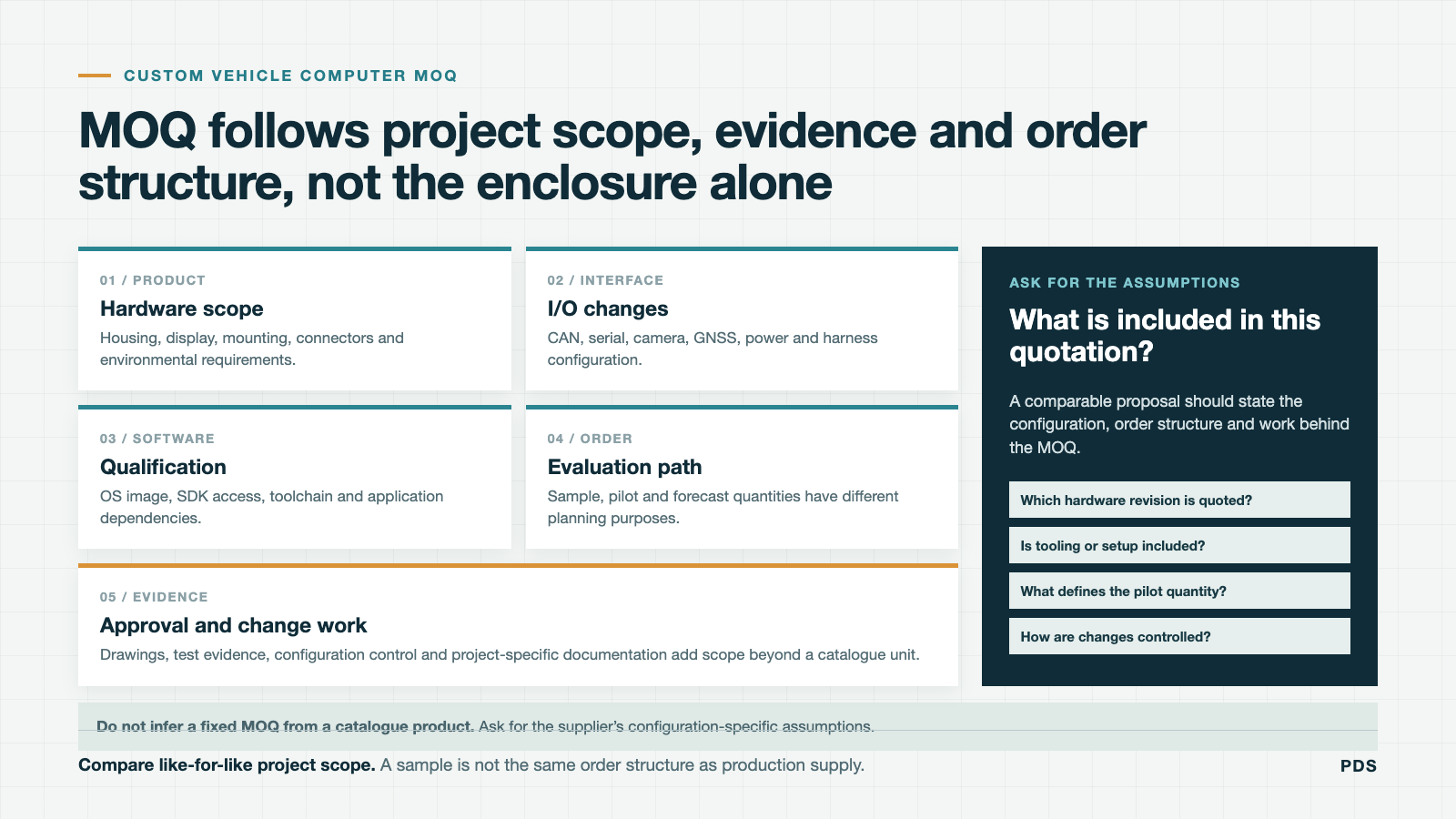
There is no universal PDS minimum to quote from the October 2026 English Catalog V3.1.
It identifies product families and customization possibilities, not commercial terms for an unfinished build.
The quantities used below belong to an invented buying example.
They are neither PDS offers nor a record of a customer's order.
Write down what “custom” changes
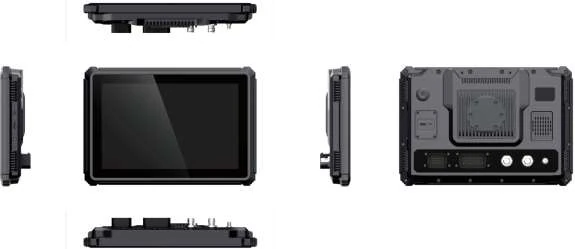
Start with a T10-based proposal that says “logo and longer cable.” Where is the logo?
A label on the back and an image shown during startup would produce different work.
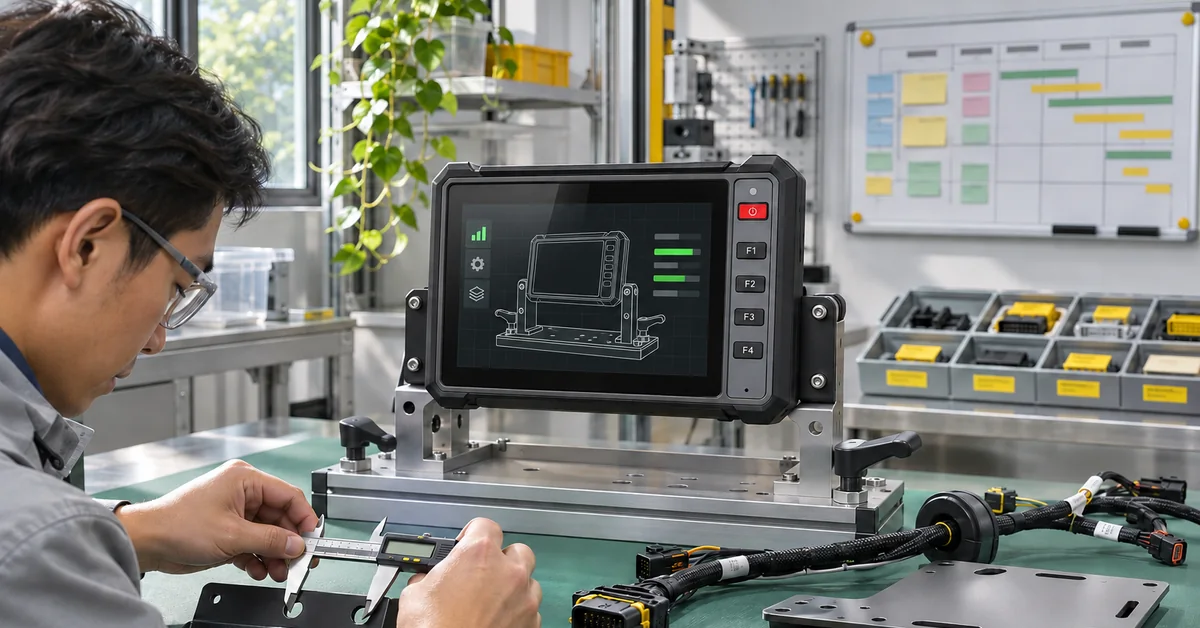
Draw the location or attach the proposed image. For the cable, the length is only one entry.
Its connector, pinout and route still have to be identified.
I would put those details into separate rows against the standard model.
For the cable, attach its required connector, pinout, length and routing constraints.
Next to startup branding, list the screen that changes and the application work, if any, expected with it.
Leave the response column empty for the supplier to identify an available option or a development task.
Keep an alternative in its own column. Perhaps the buyer can use an existing harness.
Perhaps the required connection calls for a board revision.
Those possibilities cannot be treated as the same build at two different quantities.
Otherwise a discussion about lowering the MOQ can quietly turn into agreement to a different product.
Give every quantity a name
Suppose a buyer says “100 units, delivered 25 at a time.” Put two boxes under that sentence.
One asks what is ordered now. The other asks what leaves in the first shipment.
If the buyer writes 100 in the first box and 25 in the second, that describes something different from ordering only 25 with a hope of three later orders.
The total shipped over several months might be the same. The material commitment and cancellation exposure may be quite different.
Now add a pilot. The buyer wants two units before approving production.
Are those standard units to check the application, or engineering samples with the final cable?
If the final cable is absent, the pilot cannot settle its installation.
A useful sample description says what it represents and what remains unproved.
A forecast needs its own line.
Add “200 next year” to the example, but label it forecast and note the decision it depends on.
The pilot might not yet have been accepted.
Ask the supplier to state what, if anything, it wants reserved against that forecast.
The buyer can then see whether a planning number has become a request for a commitment.
Find the item that sets the minimum
Ask the supplier to point to the item that makes the proposed quantity difficult.
Is it the selected connector, the housing work or a production setup for this revision?
The answer determines which alternative is worth discussing.
Removing a logo would not resolve a minimum caused by a different component.
There is no need to ask for a confidential supplier contract to have that conversation.
Take the proposed logo. Put the preferred location beside an acceptable alternative, if the buyer has one.
Request a response for each, keeping the rest of the build unchanged. Do the same for a connector.
The comparison should show what is gained or lost, not just present a smaller number beside the word “MOQ.”
Copy the exact model from the offer into this comparison. T7, T10 and T10B each have their own catalog entries.
If the offered model changes, go back through the operating system, interfaces and accessories rather than carrying those cells across unchanged.
A quantity belongs to the configuration beside it.
It does not cover a collection of features assembled from several catalog pages.
Read the one-time lines beside the unit price
Look below the unit-price row. If there is an engineering or tooling charge, write the expected output beside it.
A line labelled “software” might mean a prototype image, an application port or a maintained release.
Those are different jobs, even if the fee is described as one-time.
For comparison, I would place two offers next to the same change list. Now look for the harness drawing.
Who produces it in each offer?
If one response says “buyer supplied,” assign that task and its cost before calculating a saving.
The task has not disappeared simply because it is absent from an offer.
| Line to clarify | Question to put in writing |
|---|---|
| Configuration | Which named model, options and changes does this offer cover? |
| Minimum quantity | Does it apply by configuration, order, batch or shipment release? |
| Engineering | What files, builds or other deliverables are included? |
| Tooling | What is supplied, who owns it and what access is agreed? |
| Sample | Which final features are present and which remain to be validated? |
| Changes after approval | How are revisions and committed materials handled? |
| Repeat order | What validity, availability and reorder conditions apply? |
Put validation on the timetable
A changed housing, connector or radio option raises a question that a base-model document may not answer.
Put the required evidence beside the changed item and ask which document covers the offered build.
If the answer is still pending, leave a named owner and a next action there.
The schedule should show that unresolved dependency rather than quietly assuming it has been closed.
For example, “target shipment after sample approval” leaves an event to define.
Who approves the sample, against which checks, and what happens if one check is waiting for buyer information?
The date may be a reasonable target while the approval is unresolved.
It should still be labelled as a target rather than reported as a confirmed lead time.
Software support also needs a boundary. Who receives an issue after the first shipment?
Consider a proposed image update six months later. Is evaluating that image included, separately quoted or the buyer's responsibility?
Put the answer beside the initial software deliverable.
The response should identify what happens after that demonstration, even when the answer is that later work is excluded.
Describe a small first order by its purpose
A useful first order might establish the working layout, installation or revised harness.
It might simply put standard hardware in the application team's hands while a custom enclosure remains under review.
None of those purposes is wrong. The mistake is treating evidence from one as approval of the others.
In the two-sample example, I would attach a short list of open items to the pilot result.
If the cable is not final, say so. Carry that item into production approval.
The software team can use its result, while the installation team can still see the connection it has not reviewed.
Those two statuses do not have to be forced into one premature approval.
Read the PDS OEM/ODM scope and send the model, change list, sample purpose, quantities and delivery expectations through the project contact page.
Ask for configuration-specific terms. The catalog cannot supply a universal minimum for an unfinished request.
FAQ
What is PDS's custom vehicle computer MOQ?
No universal figure is verified in the supplied catalog. Request terms for the exact build, customization and order structure.
Can a sample quantity be used as the production minimum?
Do not assume so. The sample may represent different hardware or a different purpose.
Have the offer describe both stages separately.
Could a standard model change the minimum?
Ask for that configuration as an alternative.
Compare its missing or changed requirements with the original request before treating its quantity as an answer to the same job.
Does a tooling payment settle ownership?
Read the wording beside the payment.
If ownership, access or end-of-project treatment is absent, ask for it to be added to the offer.
A row saying only “tooling fee” leaves those questions open.
Contact us
📧Email: [email protected]
📞Tel: +86 13421822024
🌐Website: www.szpds.com
Disclaimer
The information in this article is for reference only. PDS Technology Co., Ltd. assumes no responsibility for errors, omissions, or suitability of the content for specific applications. Product specifications are subject to change without notice. Buyers should verify all technical details with our team before use.
About PDS Technology
PDS Technology is a leading OEM/ODM manufacturer of high-precision RTK GNSS terminals and vehicle computers, serving agriculture, construction, mining, taxi, and logistics industries since 2011.
With 15+ years of automotive-grade R&D experience, we offer rugged, multi-OS (Android/Linux/OpenHarmony) devices featuring RTK centimeter-level positioning, IP66 protection, and AI-ready performance. Our IATF16949-certified factories have produced over 100,000 units deployed globally, holding 30%+ of China's agricultural auto-steering terminal market. We export to Japan, the US, UK, Turkey, Russia, and beyond.