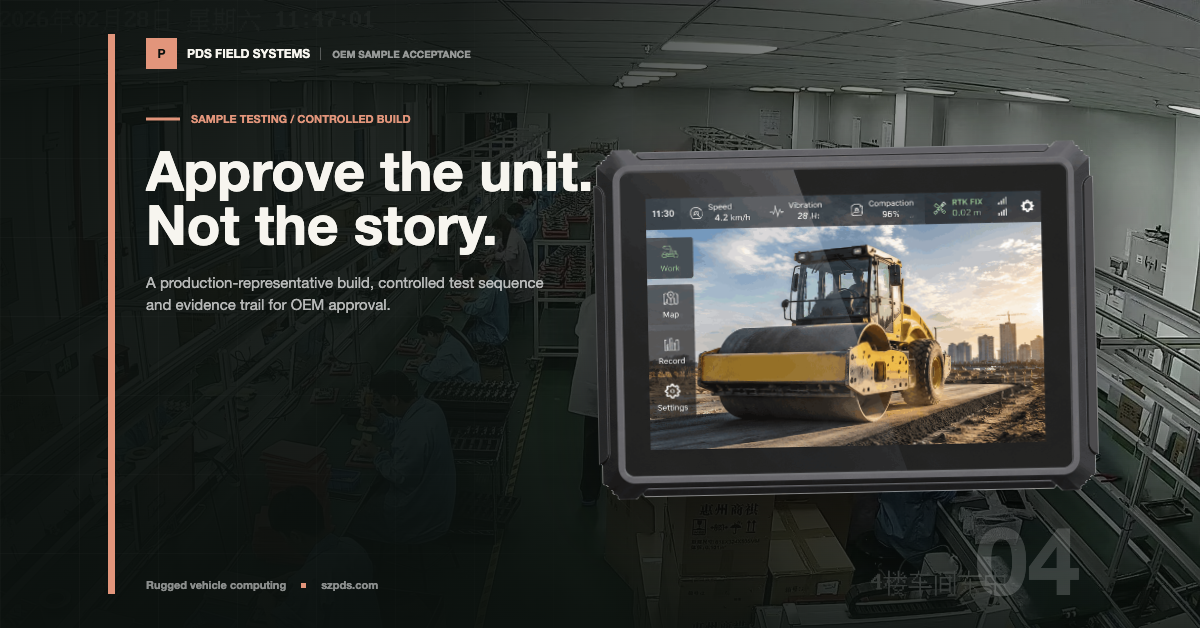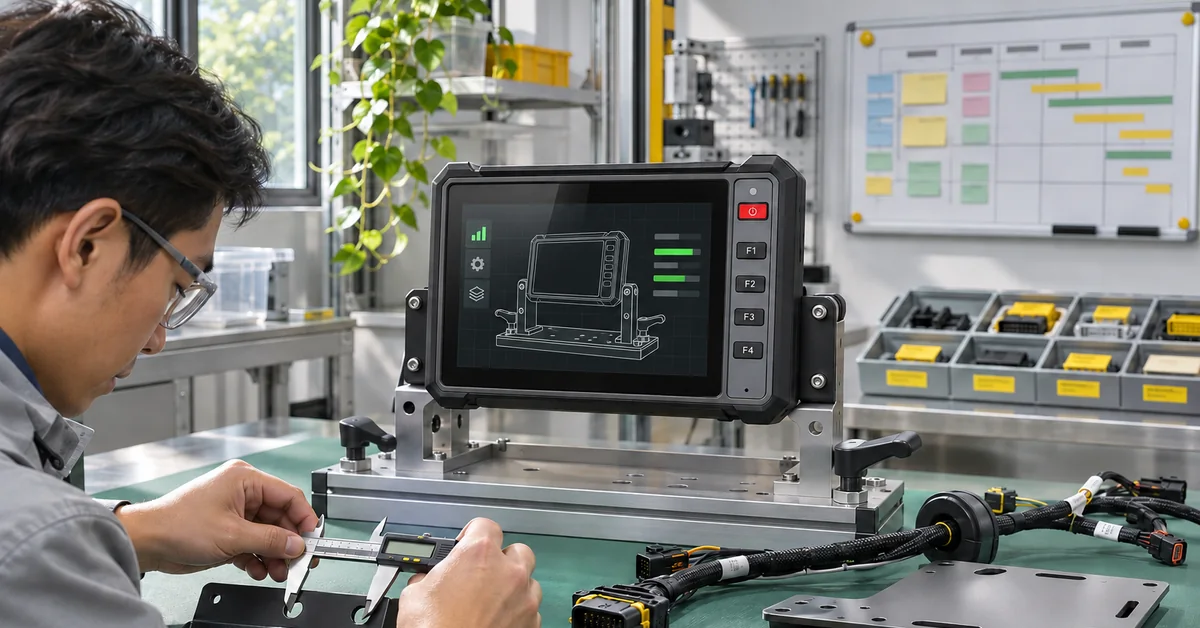

A specification sheet can tell a buyer that a vehicle computer has the right connector, screen size and operating system. It cannot tell you whether the complete assembly fits the console, survives the vehicle power sequence or can be restored by the technician who services it after delivery. Those are sample questions. They are not brochure questions.
When the sample arrives, I want to know what it represents before I turn it on. Is it a standard platform, a configured variant or a near-production prototype? The answer determines how far a test result can travel. A sample is a controlled version of the system under consideration, not merely a device to inspect.
A result has meaning only when its hardware, software, accessories and deviations are visible. Otherwise, "passed" describes a device no one can reproduce. A polished screen is only one item in the decision. Power, access, software and recovery often decide whether the sample can move toward production.
For a PDS sample, the report needs the selected family and options rather than only "10-inch vehicle computer" or "T12". Published pages describe differences in operating system, RTK option, camera support, CAN channels and power input. Check the bench unit anyway. The report must say which options are fitted. The family label is too broad for approval.
Build the workflow around the decisions the OEM must make. A vehicle computer sample test should establish the exact hardware and software baseline. Before approval, repeat the vehicle computer sample test after power interruption, device reconnect, and software recovery. If another vehicle computer sample test changes the model or build, keep its evidence separate.
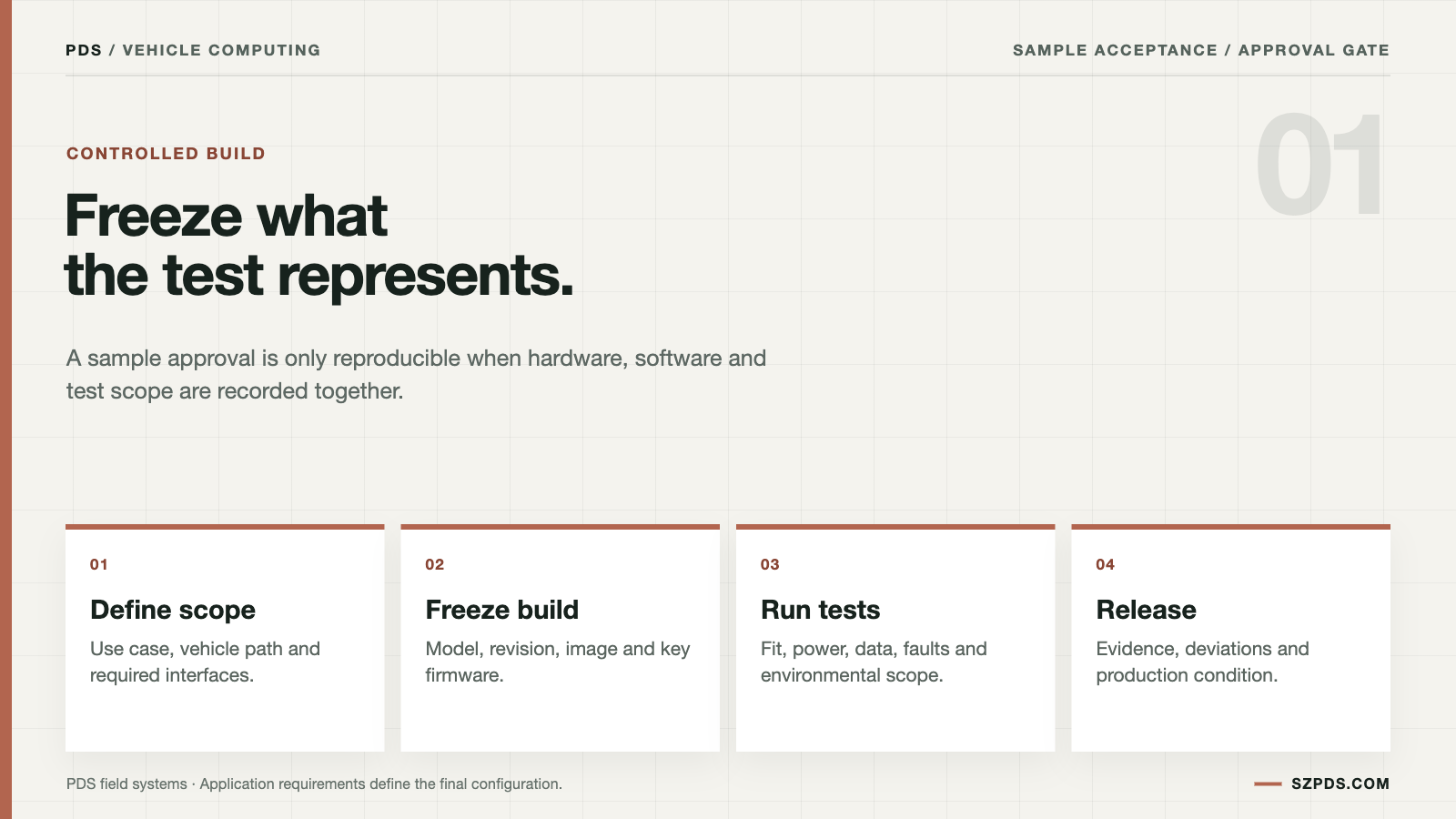
Freeze what the sample actually is
The starting record should include the model, hardware revision, storage and wireless options, software image, application build, accessory list and sample serial number. Photograph the label, connector layout and installation parts before testing begins. It is easier to identify the delivered build before the test has produced a result.
Keep a deviation list beside the bill of materials. Different memory, modem, bracket or firmware may be acceptable for early work. The approval statement still needs to say which results transfer and which must be repeated on the intended build.
This record is not paperwork for its own sake. It prevents a successful test on one configuration from being quietly applied to another.
Fit the assembly, not just the terminal
Place the terminal, bracket, harness and dock in the actual cab, or in a fixture that preserves the important dimensions. Move the seat, close the door, operate nearby controls and check the driver's sight line. A device can pass a desk test and fail the installation review in ten minutes.
With the unit mounted, the installer still has to reach the service ports. Follow the cable through its bend and movement. A connector can be technically reachable yet impossible to remove with gloves or poor light. Service access belongs in the fit decision.
Check the fuse, service latch, mounting fasteners and strain relief as well. A compact installation that requires dashboard removal for a routine replacement may be unacceptable even when the terminal performs well. The technician has to live with the assembly, not the terminal in isolation.
One photograph from the operator's eye line and another from the service position often expose different problems. Keep both with the installation drawing. The two reviewers are looking for different failures.
Run the power sequence the vehicle will run
A bench supply confirms basic startup. It does not reproduce accessory power, crank, running voltage, key-off delay or the low-voltage behavior approved for the vehicle. A bench boot leaves the power question open.
Write the expected application state before the test. Does an active job save? Does an unsent record remain in the queue? Do external devices reconnect? Does the terminal shut down immediately or wait? Without those answers, a restart can be called a pass simply because the logo appeared.
Introduce a short interruption only under the agreed vehicle procedure. Record screen, application, network and peripheral state before and after. The pass condition should describe what the operator can safely continue, not only the voltage at which the device restarts. A restart that loses the active job is a different result from one that preserves it.
Test interfaces from end to end
| Area | Test question | Evidence to keep |
|---|---|---|
| Display and controls | Can the operator read and use the job in light, vibration and gloves? | Operator notes, photographs and measured settings |
| Power | What happens during startup, crank, shutdown and interruption? | Sequence, build and observed state |
| CAN or serial | Do the required messages arrive and recover after reconnect? | Trace, mapping and fault result |
| Camera or USB | Does discovery, bandwidth and restart behavior meet the job? | Stream identity, latency and recovery record |
| GNSS | Does position remain understandable when correction is lost? | Data log and operator-facing status |
| Network | Are offline storage, retry and duplicate handling defined? | Sync result and queued-record review |
Repeat the important checks after a complete reboot. A peripheral that returns only after a service restart may be useful during development, but it is not ready for the field replacement route. Record the distinction in the approval record.
Test the software build, not a screenshot
Install the application through the deployment method the customer will use. Capture the OS, BSP, application package and peripheral firmware. Then let an operator complete the normal job before an engineer starts inspecting logs. Otherwise the test quietly becomes an engineering demonstration.
Recovery is more revealing when it is handed to a second technician. Can that person identify the build, reload the correct configuration, restore account state and decide whether the job is usable without asking the original engineer what to do? Put the answer in the approval record.
The USB-IF developer resources help frame peripheral questions, and the Linux kernel SocketCAN documentation helps frame Linux CAN questions. Neither source replaces a test on the selected hardware and product image.
Startup branding, permissions, account state and package updates belong in the software baseline too. A changed logo says nothing about who owns recovery.
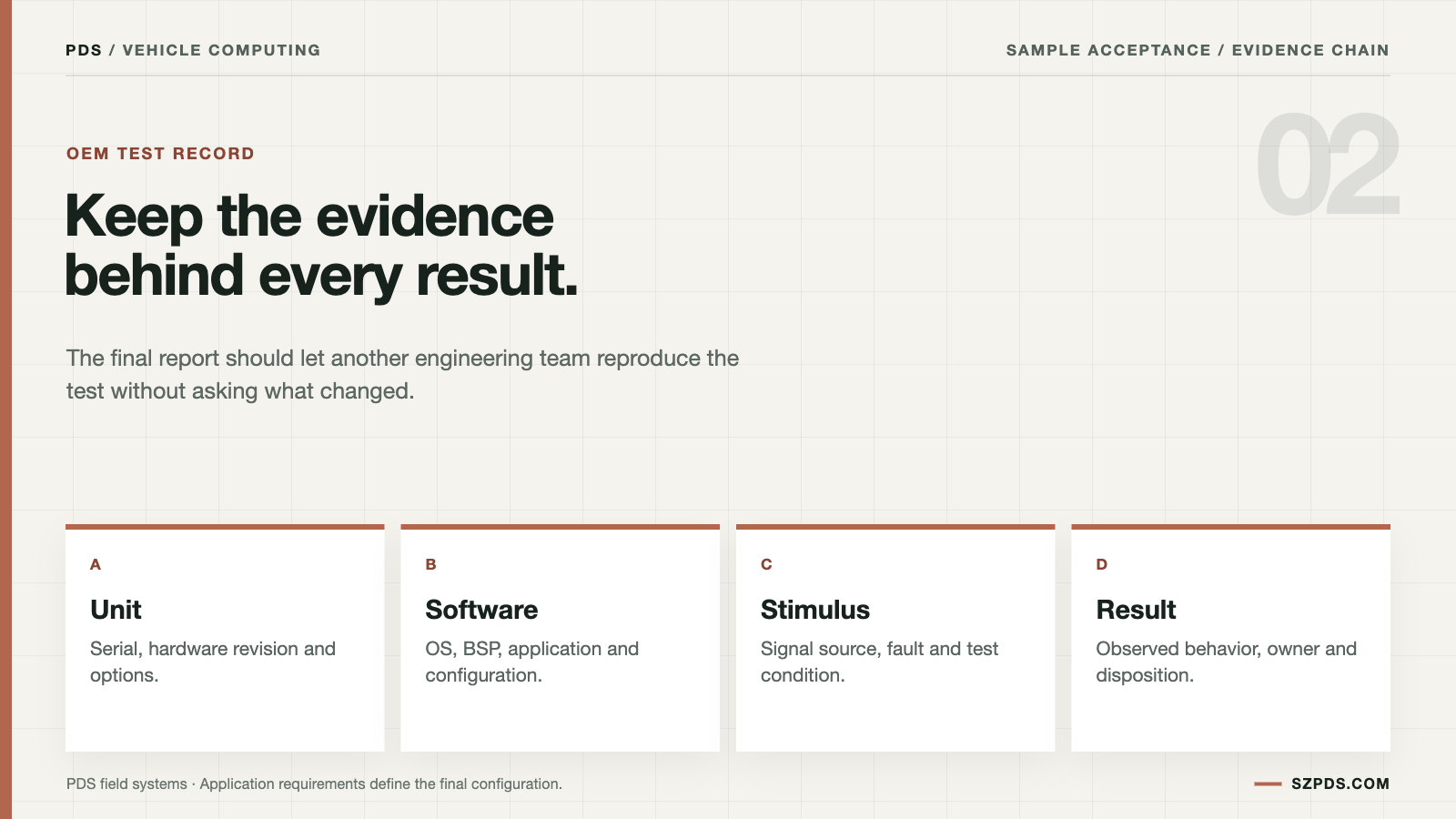
Separate platform evidence from sample evidence
A supplier report may cover a platform family. The buyer still has to know which enclosure, display, storage, connectors, wireless option and mounting were included. Family-level evidence does not automatically describe the sample on the bench.
Compare the tested configuration with the proposed bill of materials. Then ask whether the evidence covers the environmental and electrical conditions that matter to the intended installation. Similar is not the same as covered.
A related-model result does not close the question automatically. Write down the technical difference and request the evidence that addresses it. If the difference remains open, keep the item as an approval hold point rather than smoothing it over in the summary.
Production quality evidence is separate from sample performance. Ask how incoming inspection, key process controls, traceability and final tests will be repeated on the intended line.
Try the replacement route before approval
Where the project permits, unplug and replace the terminal, camera, GNSS receiver and storage device. Time the task and note the tools, credentials and configuration files required. A replacement route that exists only in a design document remains untested.
The replacement must receive the correct customer configuration without inheriting another customer's data. Device identity, licenses and account assignment need a stated procedure and a verification step. A successful image load alone does not close the check.
Use a technician who did not design the system. If recovery depends on a private conversation with one engineer, the service process is not ready for approval.
| Approval gate | Question | Record |
|---|---|---|
| Configuration | Does the sample match the planned production build? | Revision, BOM and deviation list |
| Installation | Does the complete assembly fit and remain serviceable? | Drawing, photographs and sign-off |
| Function | Do the agreed operator workflows pass repeatedly? | Test IDs, results and build identity |
| Recovery | Can a trained technician restore the system? | Recovery record and elapsed time |
| Production | Can the checks and traceability be repeated at volume? | Control plan and final-test record |
Use a conditional approval honestly
A sample is not approved because a short demonstration produced no visible problem. Approval needs a result for each required gate, including the gates that are less visible from the driver's seat. Quiet operation by itself proves little.
If a modem variant, bracket revision or application build remains untested, call it a hold point. Conditional approval can be practical, but the open condition needs an owner, a retest date and a clear statement of what cannot yet be claimed.
Use the PDS RFQ checklist, pilot-to-production guide and OEM/ODM process to align technical and commercial scope. Start model selection from the vehicle computer range and keep the sample tied to a specific configuration.
Leave an audit trail from the field trial
Run the ordinary job in the target vehicle. Include a restart, a device reconnect, a network loss and end-of-shift shutdown. The operator can explain which messages were clear; the technician can explain which service step took the most time. Keep both views in the report. A sample approval has to serve both groups.
If a defect appears, preserve the build and logs before changing the setup. Reproduce the issue, apply one controlled change and test the fix on a newly identified build. Otherwise it is difficult to tell whether the repair fixed the cause or only changed the conditions.
The final report should show what passed, what failed, what changed and what remains open. It becomes the reference point for production acceptance and for the next sample if a gate must be repeated.
FAQ
How many samples should an OEM order?
Base the quantity on installation variants, software roles, test teams and spare needs. Decide the purpose of every sample before ordering. A service spare is not the same as a sample for environmental testing.
Can a standard sample support a custom project?
It can support early evaluation. Final approval still has to cover the intended custom configuration and every material difference that can affect fit, power, interfaces or recovery.
How long should sample testing take?
Set the time from the test scope and decision gates. A required environmental or software test should not be compressed simply to meet a sample date.
Should the application be prepared before the sample arrives?
Yes, where possible. Early package and platform review lets the sample session focus on integration evidence instead of discovering missing inputs.
Are supplier test reports enough?
They are evidence for a defined method and configuration. Check that the method, model, options and intended installation answer the approval question.
What is the most important power test?
The approved vehicle startup and shutdown sequence, including interruption, active-job state and recovery behavior. A bench boot alone is not enough.
Must every peripheral be tested?
Test every device required for the first production release. Later devices can be added through a controlled compatibility process, but they cannot be silently included in the original approval.
How should the sample be labeled?
Use a unique identifier tied to hardware and software records. Keep photographs, logs, deviations and retest results under that identifier.
Can approval be conditional?
Yes. List the open condition, owner and retest date. Conditional work is not complete production evidence.
When is the sample approved?
When the functional, installation, recovery and production gates pass on the controlled configuration, with remaining risks and deviations documented. An open hold point means the sample is not fully approved.
Conclusion
A vehicle computer sample is useful when it represents the system the OEM expects to build. Fit, power, data, software and service all influence the approval decision, even when the screen itself looks fine.
Identify the build, test the real workflow and keep the evidence together. Production then has a clear starting point, including the cases where the correct decision is to hold the sample.
Contact us
Email: [email protected]
Tel: +86 13421822024
Website: www.szpds.com
About PDS Technology | Contact PDS Technology | Privacy and terms inquiries
Disclaimer
The information in this article is for reference only. PDS Technology Co., Ltd. assumes no responsibility for errors, omissions, or suitability of the content for specific applications. Product specifications are subject to change without notice. Buyers should verify all technical details with our team before use.
About PDS Technology
PDS Technology is a leading OEM/ODM manufacturer of high-precision RTK GNSS terminals and vehicle computers, serving agriculture, construction, mining, taxi, and logistics markets since 2011.
With 15+ years of automotive-grade R&D experience, we offer rugged, multi-OS (Android/Linux/OpenHarmony) devices featuring RTK centimeter-level positioning, IP66 protection, and AI-ready performance. Our IATF16949-certified factories have produced over 100,000 units deployed globally, holding 30%+ of China's agricultural auto-steering terminal market. We export to Japan, the US, UK, Turkey, Russia, and beyond.