
A vehicle computer for software developers can look convincing in ten minutes.
The application opens, the map appears and a button changes color.
The awkward question comes later: where did the operator's last job go after shutdown?
For a software integrator, that question deserves a place in the sample request, alongside the screen size and processor. A vehicle computer for software developers also needs this evidence before the sample becomes a reference design.
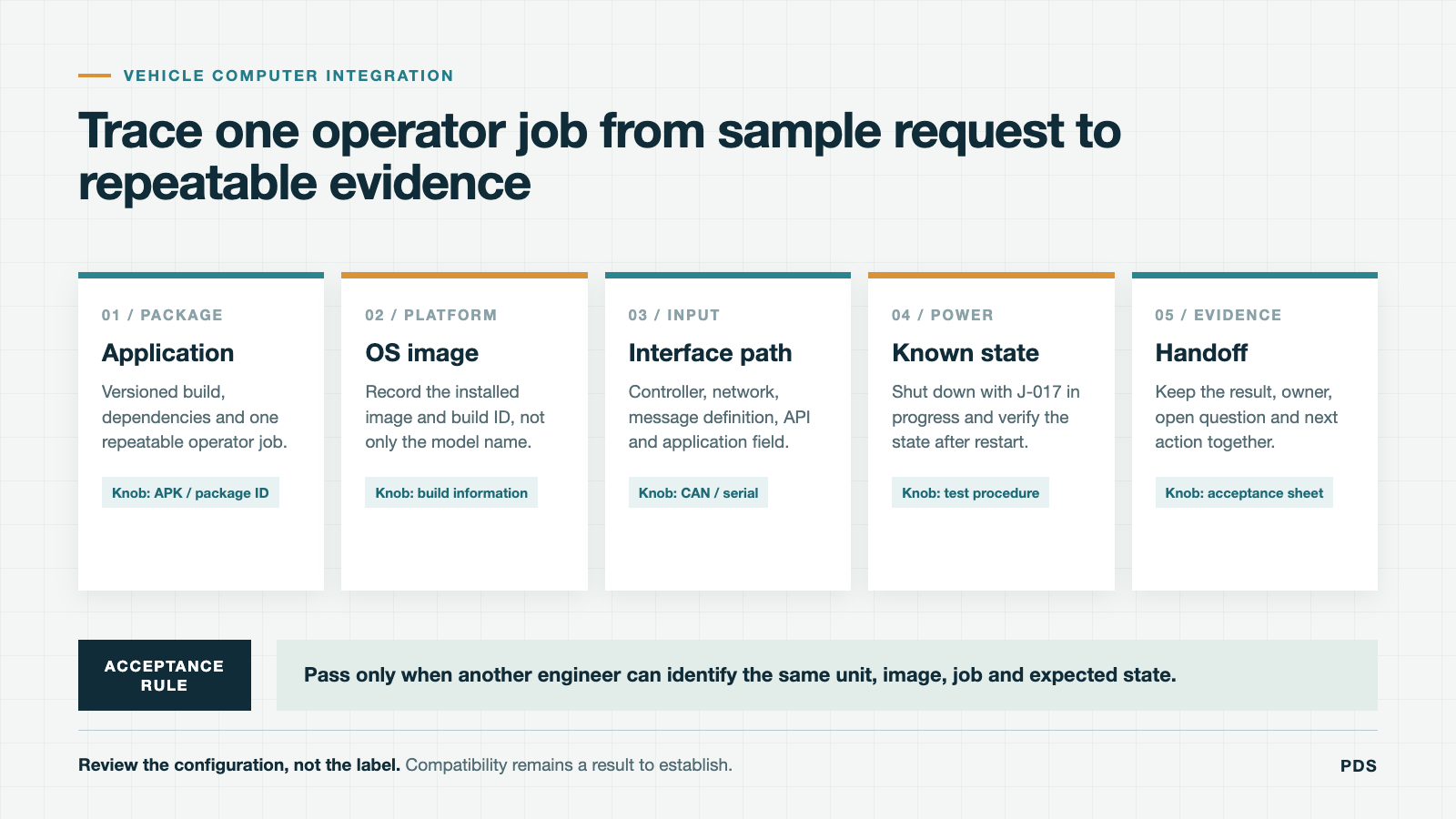
I would start the review with one ordinary job and follow its record through the terminal.
The examples here describe a proposed test using invented data. They are not results from a PDS customer installation.
Product references come from the October 2026 PDS English Catalog V3.1.
Follow the job, including its unfinished state
Suppose the test job is J-017. The operator accepts it, changes its status and saves it.
Somewhere along that path, the application has to contact a server. Put a mark beside that point.
If the server is unavailable, the operator still needs to know whether the job was accepted locally or has not been saved at all.
The word “saved” is surprisingly unhelpful on its own.
It could describe a local database write, an item in an upload queue or a record acknowledged by the server.
A screen recording may show the button press without settling which of those events occurred.
The acceptance sheet needs the expected state and a way to find the corresponding record.
There is no need to copy production customer records into this exercise.
A test account and made-up job identifiers are easier to trace. Keep the same small dataset for a second run.
If J-017 appears twice after reconnection, the review has found a different problem from a missing job, even though both might arrive as “sync failed” in an issue report.
Name the image on the sample
Start by opening the sample's build information.
Copy that identifier into the review rather than writing only “T10” or “Android.” In the catalog, T7, T8 and T10 sit under Android 10 and Linux Buildroot options, with kernel 4.9 and Qt 5 listed.
A separate comparison covers T8B, T10B and T12, including Android 13. The tables describe available platforms.
Neither table identifies the image installed on a particular sample.
Suppose J-017 depends on a background service and a native library.
The useful question is whether those two dependencies work on the offered build.
An application opening successfully does not answer it.
Send the dependencies with the package, including anything the supplier needs to reproduce the issue.
If the service remains an open question, keep J-017's background check open too.
That avoids spending a review debugging behavior that nobody has agreed to support.
The Android versus Linux guide provides background for that choice.
For the actual test, write down the build installed on the unit.
Otherwise, an engineer trying to reproduce a problem later may be using the right model with the wrong image.
Trace the input that the application uses
Take one machine-status value arriving over CAN.
On the review sheet, give it a route: controller, network, message definition, software access method and application field.
Each stop should have an owner.
If the controller's message definition has not arrived, no amount of checking the display field will supply it.
T10B lists SocketCAN support in the catalog.
For a Linux sample, I would ask which supplied image and documentation go with that entry.
For an Android sample, I would ask how the application receives the required CAN value.
These are separate questions for the quotation.
Leaving one answer blank is more honest than copying the other operating system's answer into it.
Position data deserves the same treatment. A current fix and an old fix may contain plausible coordinates.
What tells the application which one it has received?
In the sample exercise, the receiver choice, output format and required status behavior belong together.
Camera review is similarly specific: name the view, the required configuration and the application workload running beside it.
A compact sample acceptance sheet
| Item | What accompanies the sample request | What the reviewer keeps |
|---|---|---|
| Application | Package version, dependencies and one operator job | Job result on the identified OS build |
| CAN or serial feed | Peripheral model, permitted protocol data and harness revision | Timestamped input beside its app value |
| Position | Receiver choice, output format and required states | Current, stale and unavailable presentations |
| Camera | Agreed format, channel needs and viewing sequence | Required view under the intended workload |
| Power states | Approved vehicle test procedure | Job status before shutdown and after restart |
| Repeatability | Another unit with the same released configuration | Repeated results and explained differences |
I would leave a separate space for “waiting for information.” A missing protocol is not evidence of a defective terminal.
Nor is it a pass.
Putting an owner and a next action beside that status stops an open question from becoming an accidental approval.
Restart with something left to finish
Begin the power-state review with J-017 in progress, not with an empty home screen.
Under the approved vehicle procedure, take the application to a known point and follow the agreed shutdown sequence.
On restart, find that job again.
Its status, pending upload and any operator message are the objects of the software check.
The catalog's 9-36 V input reference does not design the vehicle connection.
Harness protection and the electrical test method need approval from the vehicle electrical team.
The application team can specify the data states it needs to observe without improvising a wiring experiment.
For an offline job, agree on the expected sequence before the test.
Perhaps the application retains a local record, displays a pending state and uploads when coverage returns.
That is a proposed behavior to check, not a product promise.
The review is more useful when the expected outcome has been written before anyone sees the result.
Leave a record another person can use
The hardware revision, selected options, harness, OS image and application version should stay together.
When an update is proposed, compare it with that configuration. The change determines which checks need repeating.
A product-family label cannot tell a service engineer whether a particular result applies to the unit being repaired.
Try one last handoff before closing the sample review.
Ask a colleague who did not build the application to locate its version and retrieve an agreed diagnostic record.
Keep restricted data out of the handoff exercise and decide who authorizes recovery or an update.
For a vehicle computer for software developers, a procedure that works only with its developer present is still unfinished.
For a PDS sample discussion, identify a starting model in the product range and send the requirements through the project contact page.
The catalog references above use pages 6, 9 and 10. Compatibility remains a result to establish on the supplied build.
FAQ
Does the right Android version mean the app will work?
No. The package may open while a required library or service is still unsupported.
Try the complete operator job on the proposed image and keep both build identifiers with the result.
What should accompany a vehicle computer sample request?
A versioned application package, dependency list, interface list and repeatable operator job.
Installation constraints and nonproduction test data make the request easier to evaluate.
Who decodes the CAN messages?
Assign that responsibility in the project.
Physical access, the software API and permission to use the message definitions are separate questions.
Must every test be repeated after an update?
The answer depends on the change.
Compare it with the approved configuration, identify affected checks and keep the retest decision with the results.
Contact us
📧Email: [email protected]
📞Tel: +86 13421822024
🌐Website: www.szpds.com
Disclaimer
The information in this article is for reference only. PDS Technology Co., Ltd. assumes no responsibility for errors, omissions, or suitability of the content for specific applications. Product specifications are subject to change without notice. Buyers should verify all technical details with our team before use.
About PDS Technology
PDS Technology is a leading OEM/ODM manufacturer of high-precision RTK GNSS terminals and vehicle computers, serving agriculture, construction, mining, taxi, and logistics industries since 2011.
With 15+ years of automotive-grade R&D experience, we offer rugged, multi-OS (Android/Linux/OpenHarmony) devices featuring RTK centimeter-level positioning, IP66 protection, and AI-ready performance. Our IATF16949-certified factories have produced over 100,000 units deployed globally, holding 30%+ of China's agricultural auto-steering terminal market. We export to Japan, the US, UK, Turkey, Russia, and beyond.