
What Affects the Cost of an OEM Vehicle Computer? A Buyer Guide
Two OEM vehicle computer quotations can look similar on the first line and cover very different work.
One may include the mount, harness, software integration, validation record and service plan. The other may price only the terminal.
The useful comparison therefore begins below the unit price. Align the product, engineering, evidence and commercial assumptions first.
“IATF 16949 is the global technical specification and quality management standard for the automotive industry.”
Source: IATF Global Oversight
A low device price can become an expensive project after installation.
An inclusive quote can also hide an assumption that was never discussed.
This OEM vehicle computer cost guide explains what changes cost.
It does not publish a price, MOQ or lead time for an unspecified PDS configuration.
Start with a standard platform
I start with the least surprising platform.
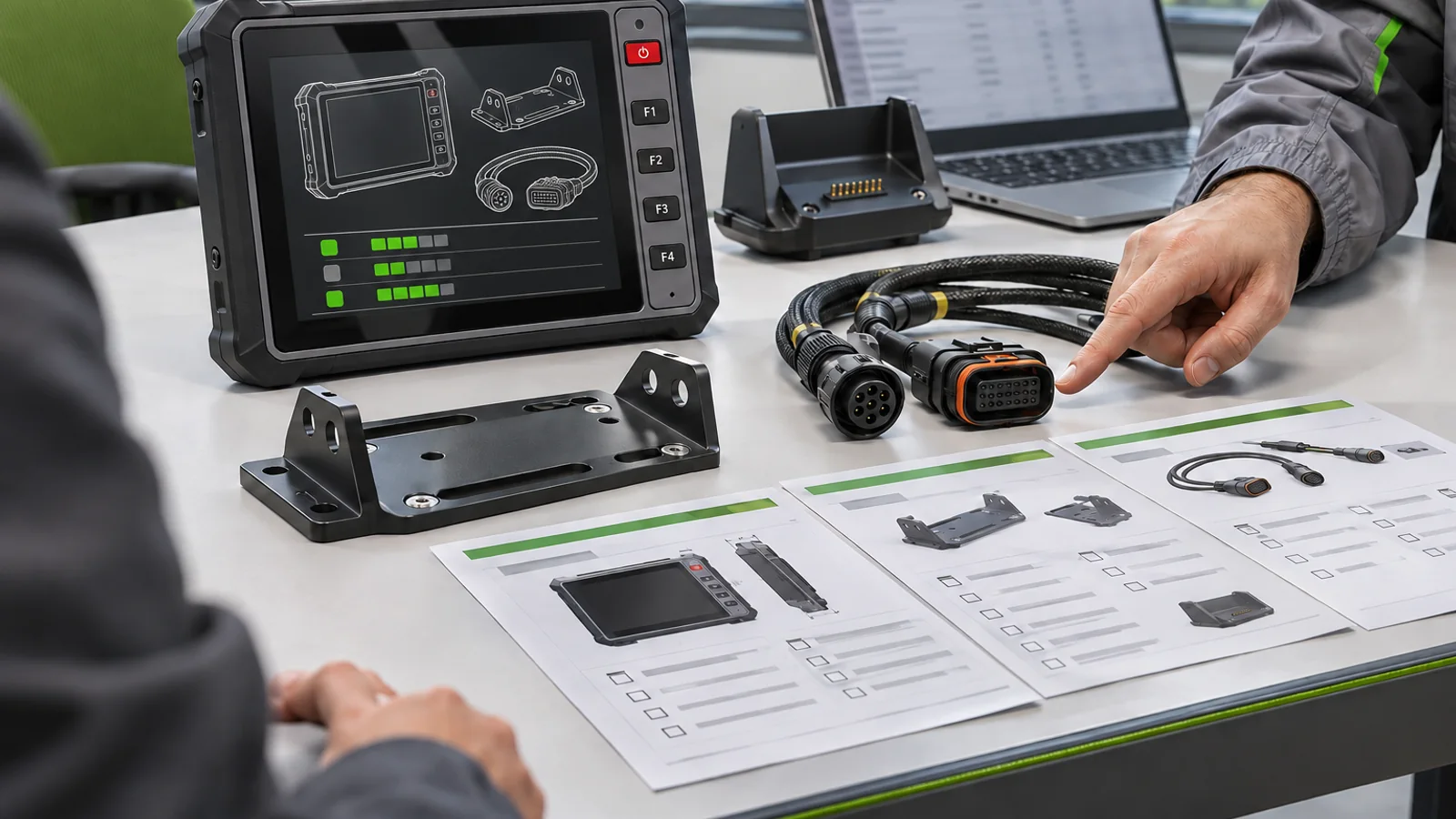
An existing model and documented option set let the buyer inspect the screen, OS, mount and ports before anyone opens a new drawing.
Now list every departure from that base. The enclosure, connector position, logo, boot sequence and software image all count.
Give each row a status: standard, configurable or new work.
If two suppliers use different labels, ask for the drawing and test behind each one.
A connector move can look tiny in a review.
It may still reshape the housing, cable assembly, validation record and service instructions.
Start the review with the PDS vehicle computer range and OEM/ODM process.
Count the whole installation
Screen size affects cab space, viewing position and glove operation.
A larger display may need a different bracket, housing and cable route.
Record the installed envelope and service clearance. A product can fit the photograph and still block a latch or door.
Buttons, touch behavior, sunlight and cleaning practice can change the enclosure choice.
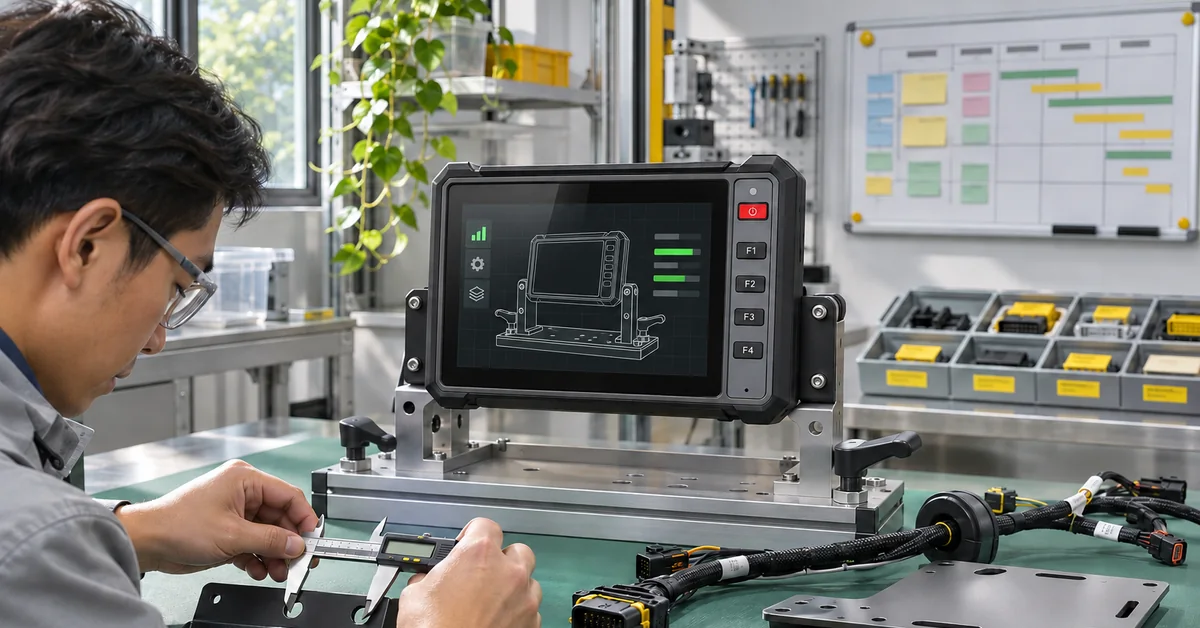
Compare the mount and harness as part of the same configuration.
The 7-inch versus 10-inch display review shows why the installed area matters more than diagonal size alone.
Price interface changes by the work
Each interface needs a function, electrical requirement, protocol owner, driver path and test method.
A documented standard port is different from a new connector, extra channel or nonstandard pinout.
The cable assembly needs its own design and part identity. Include strain relief, route length, labeling and service replacement.
If several peripherals run together, ask how their drivers, bandwidth and power demand were tested as one workload.
An interface list without the harness or validation scope leaves part of the project unpriced.
Match validation to the target market
The vehicle, operating environment and destination market decide which evidence is relevant.
Temperature, ingress protection, vibration, electrical conditions and wireless equipment may need additional review.
A general product claim is not approval for every configuration. Request the test scope, certificate and model identity that apply.
The ISO 16750-2 listing is an example of the official material behind an electrical-load question.
It does not show that a specific terminal has passed the relevant project test.
Regulatory work changes both engineering effort and schedule. Put the evidence requirement into the RFQ when the market is known.
Define software work in deliverables
“Custom software” can mean a boot logo, a driver change, interface access or a complete application.
Name who supplies the app, image, BSP, SDK and recovery method. Name who supports each after release.
Branding, device access and application development carry different engineering and maintenance duties.
Use the software integrator checklist to define the tested stack and acceptance evidence.
A logo change is not a software requirements document.
A software support promise without a build boundary is not a support plan.
Explain how order structure affects supply
Quantity, variants, delivery pattern and approval stages shape material and production planning.
Several low-volume variants may need separate labels, images, records and tests. A stable configuration is easier to reproduce.
Sample, pilot and production orders can use different commercial terms because they serve different stages.
Do not infer a production price from an unrelated sample.
The MOQ guide explains why the order structure belongs in the review.
Compare offers with a line-item matrix
| Cost area | Question for each supplier | Deliverable | Risk if omitted |
|---|---|---|---|
| Platform | Which model, revision and options are quoted? | Configuration sheet | Different products are compared |
| Mount and harness | Are bracket, cable and drawings included? | Part list and installation assumptions | Fit cost appears after award |
| Interfaces | Are required ports standard or new work? | Interface matrix and test scope | Protocol support stays open |
| Software | Who supplies the image, BSP and app? | Build ownership and acceptance plan | Integration becomes open-ended |
| Validation | Which reports apply to this configuration? | Test scope and model identity | A general claim is mistaken for approval |
| Volume | How do quantity and mix change the offer? | Quantity structure and assumptions | Order structures are incompatible |
| Service | What records, spares and support are included? | Service responsibilities | Recovery cost sits outside the decision |
Send an RFQ that supports comparison
| RFQ input | What to specify | Why it affects cost |
|---|---|---|
| Application | Vehicle, operator job, environment and critical data | Defines platform and validation relevance |
| Installation | Space, mount, service access and power owner | Determines hardware and installation scope |
| Interfaces | Protocol, count, timing, drivers and peripherals | Separates standard work from new engineering |
| Software | Image, SDK, app owner, updates and recovery | Defines integration and lifecycle support |
| Evidence | Tests, reports, sample acceptance and market | Changes engineering and documentation work |
| Commercial | Quantity, variants, timing, delivery and forecast | Shapes procurement and production planning |
Include the support path in the cost
A unit that is easy to identify, install and replace can reduce service effort across the fleet.
Ask how a replacement receives the correct image and configuration. Check whether commissioning records are supplied.
Include buyer work too. Cable matching, test data and unresolved interface ownership consume engineering time.
Mark each requirement as confirmed, assumed or open.
This is more useful than applying a broad contingency without saying what it covers.
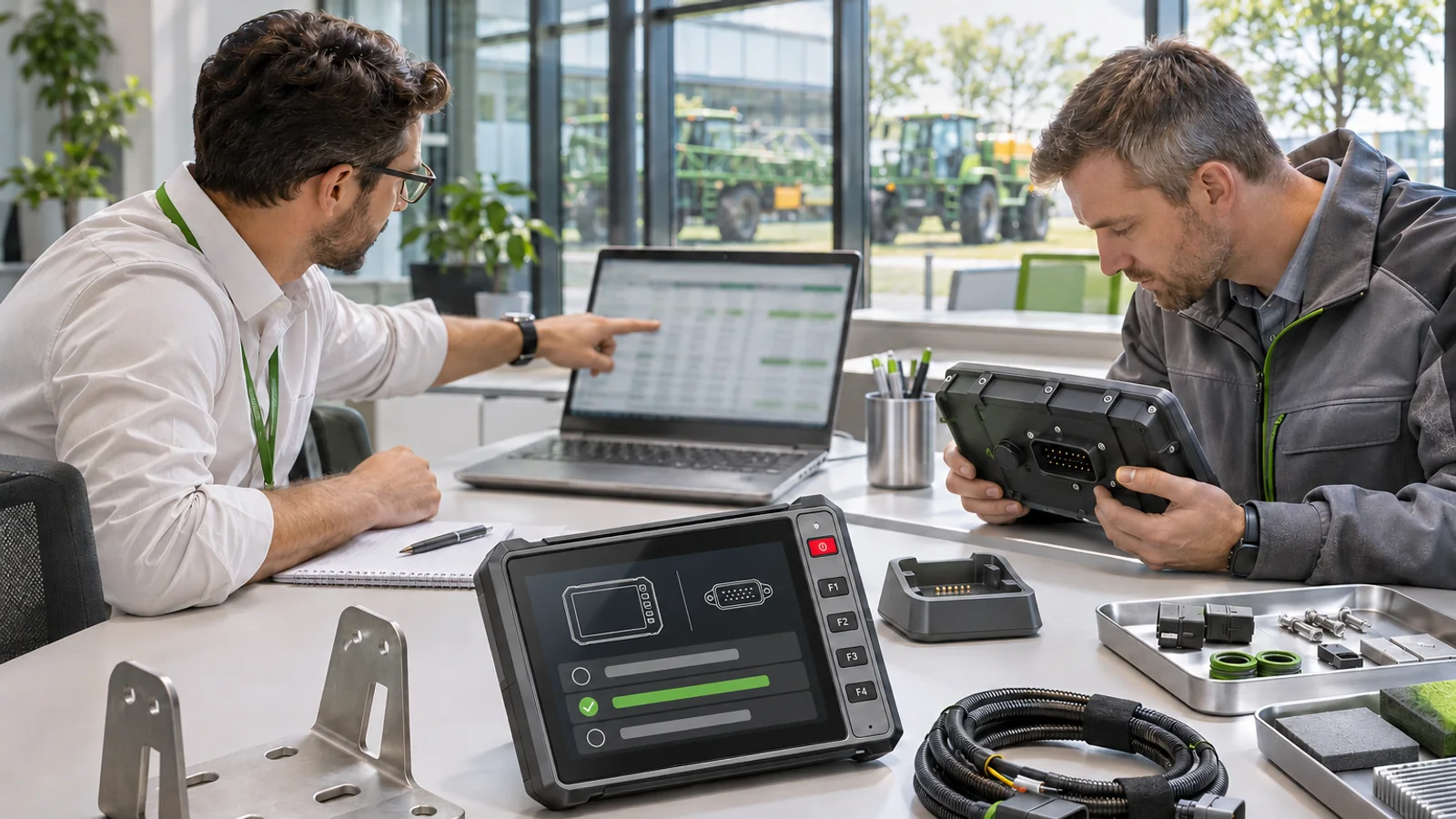
Use the same specification with every supplier, then compare exceptions as well as totals.
For a PDS review, use the vehicle computer RFQ checklist before sending the package through the project contact page.
FAQ
Can PDS publish a price for an unspecified vehicle computer?
No. Configuration and commercial scope must be defined before a useful quotation can be prepared.
Why can similar-looking units have different costs?
Enclosure, connectors, accessories, software, testing and volume may differ.
Does a higher quantity always lower the unit price?
No universal result applies. Materials, variants and commercial terms also matter.
Should the harness be quoted with the terminal?
One scope can reduce interface gaps. The buyer should still define installation ownership.
Is software customization included in OEM/ODM?
The project must state the software scope. Branding, drivers and app development are different work.
How can validation costs be compared?
Use the same vehicle, market and evidence request. Identify tests for the exact model.
Should samples and production units share a configuration?
They should be traceable to the configuration under review. Record and assess every difference.
Does a low-volume pilot need a separate quote?
It often has a different scope. Ask for the pilot assumptions rather than extrapolating a headline price.
What is commonly missing from an RFQ?
An unclear system boundary. Name the owners of the device, mount, harness, app and acceptance evidence.
How should buyers handle cost uncertainty?
Separate confirmed scope, assumptions and open options. Resolve high-impact unknowns before ranking offers.
Contact us
Email: [email protected]
Tel: +86 13421822024
Website: www.szpds.com
About PDS Technology | Contact PDS Technology | Privacy and terms inquiries
Disclaimer
The information in this article is for reference only. PDS Technology Co., Ltd. assumes no responsibility for errors, omissions, or suitability of the content for specific applications. Product specifications are subject to change without notice. Buyers should verify all technical details with our team before use.
About PDS Technology
PDS Technology is a leading OEM/ODM manufacturer of high-precision RTK GNSS terminals and vehicle computers, serving agriculture, construction, mining, taxi, and logistics markets since 2011.
With 15+ years of automotive-grade R&D experience, we offer rugged, multi-OS (Android/Linux/OpenHarmony) devices featuring RTK centimeter-level positioning, IP66 protection, and AI-ready performance. Our IATF16949-certified factories have produced over 100,000 units deployed globally, holding 30%+ of China's agricultural auto-steering terminal market. We export to Japan, the US, UK, Turkey, Russia, and beyond.